 Image 1 of 1
Marble Infection
Acrylic on Canvas | 9 × 12 in
Where permanence meets decay, and stone remembers it was once alive.
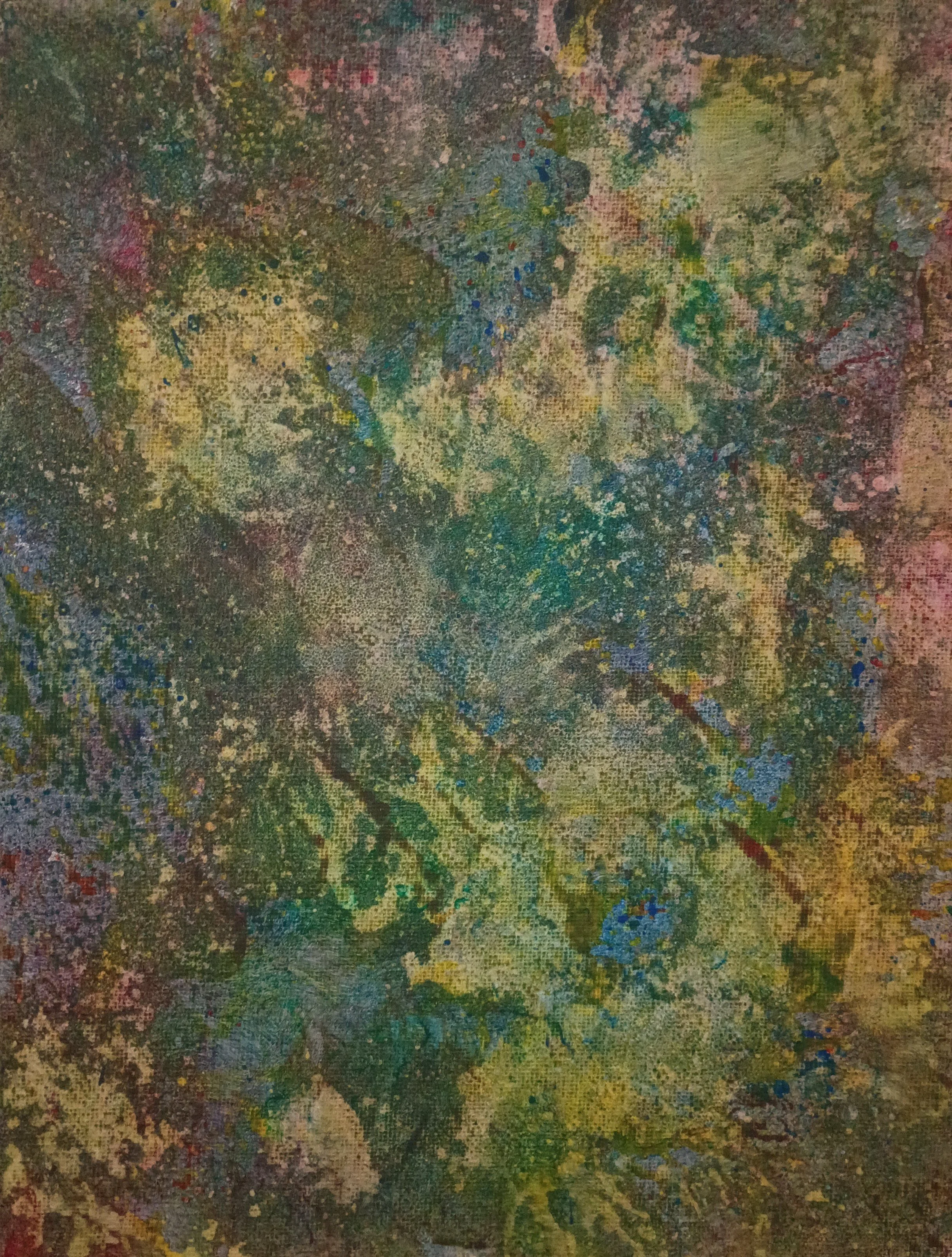
At first glance, Marble Infection evokes the mineral depth of ancient stone, its mottled greens, muted golds, and fractured blues recalling the veins of marble quarried since antiquity for temples, monuments, and tombs. Yet unlike the permanence of classical marble, the surface here feels unstable, as though the material itself is alive and undergoing transformation. The painting’s organic splatters and spreading pigments resemble biological growth, suggesting an unseen force slowly permeating the canvas.
Vince’s first exploration into abstraction embraces spontaneity rather than control. The composition emerges through layered pigments and chance interactions, echoing artistic movements such as Abstract Expressionism, where artists like Jackson Pollock and Helen Frankenthaler allowed gesture, gravity, and fluidity to become collaborators in the creative process. In this sense, the work becomes less about depicting a scene and more about revealing a process, creation unfolding in real time.
The title Marble Infection introduces a compelling tension between permanence and decay. Marble, historically associated with endurance and immortality, from the sculptures of ancient Greece to the cathedrals of the Renaissance, is here imagined as something vulnerable, capable of contamination. The artist draws inspiration from the fictional cordyceps infection depicted in The Last of Us, a fungus that overtakes its host, spreading silently beneath the surface before erupting into visible transformation.
Within the painting, the creeping greens and branching forms suggest a kind of microscopic landscape: part geological, part biological. It becomes difficult to determine whether the viewer is observing the slow formation of stone over millennia or the rapid colonization of an organism. This ambiguity invites a broader reflection on the cycles of nature: growth and decay, order and entropy, creation and corruption.
Ultimately, Marble Infection captures a moment of artistic liberation. By relinquishing strict control and allowing color and movement to guide the work, the artist mirrors the very phenomenon the painting evokes, an organic process spreading across the surface. What begins as an experiment becomes an allegory for transformation itself, reminding us that even the most solid structures, stone, systems, or certainty are never entirely immune to change.
Marble Infection
Acrylic on Canvas | 9 × 12 in
Where permanence meets decay, and stone remembers it was once alive.
At first glance, Marble Infection evokes the mineral depth of ancient stone, its mottled greens, muted golds, and fractured blues recalling the veins of marble quarried since antiquity for temples, monuments, and tombs. Yet unlike the permanence of classical marble, the surface here feels unstable, as though the material itself is alive and undergoing transformation. The painting’s organic splatters and spreading pigments resemble biological growth, suggesting an unseen force slowly permeating the canvas.
Vince’s first exploration into abstraction embraces spontaneity rather than control. The composition emerges through layered pigments and chance interactions, echoing artistic movements such as Abstract Expressionism, where artists like Jackson Pollock and Helen Frankenthaler allowed gesture, gravity, and fluidity to become collaborators in the creative process. In this sense, the work becomes less about depicting a scene and more about revealing a process, creation unfolding in real time.
The title Marble Infection introduces a compelling tension between permanence and decay. Marble, historically associated with endurance and immortality, from the sculptures of ancient Greece to the cathedrals of the Renaissance, is here imagined as something vulnerable, capable of contamination. The artist draws inspiration from the fictional cordyceps infection depicted in The Last of Us, a fungus that overtakes its host, spreading silently beneath the surface before erupting into visible transformation.
Within the painting, the creeping greens and branching forms suggest a kind of microscopic landscape: part geological, part biological. It becomes difficult to determine whether the viewer is observing the slow formation of stone over millennia or the rapid colonization of an organism. This ambiguity invites a broader reflection on the cycles of nature: growth and decay, order and entropy, creation and corruption.
Ultimately, Marble Infection captures a moment of artistic liberation. By relinquishing strict control and allowing color and movement to guide the work, the artist mirrors the very phenomenon the painting evokes, an organic process spreading across the surface. What begins as an experiment becomes an allegory for transformation itself, reminding us that even the most solid structures, stone, systems, or certainty are never entirely immune to change.