Shop
Shop
Filters
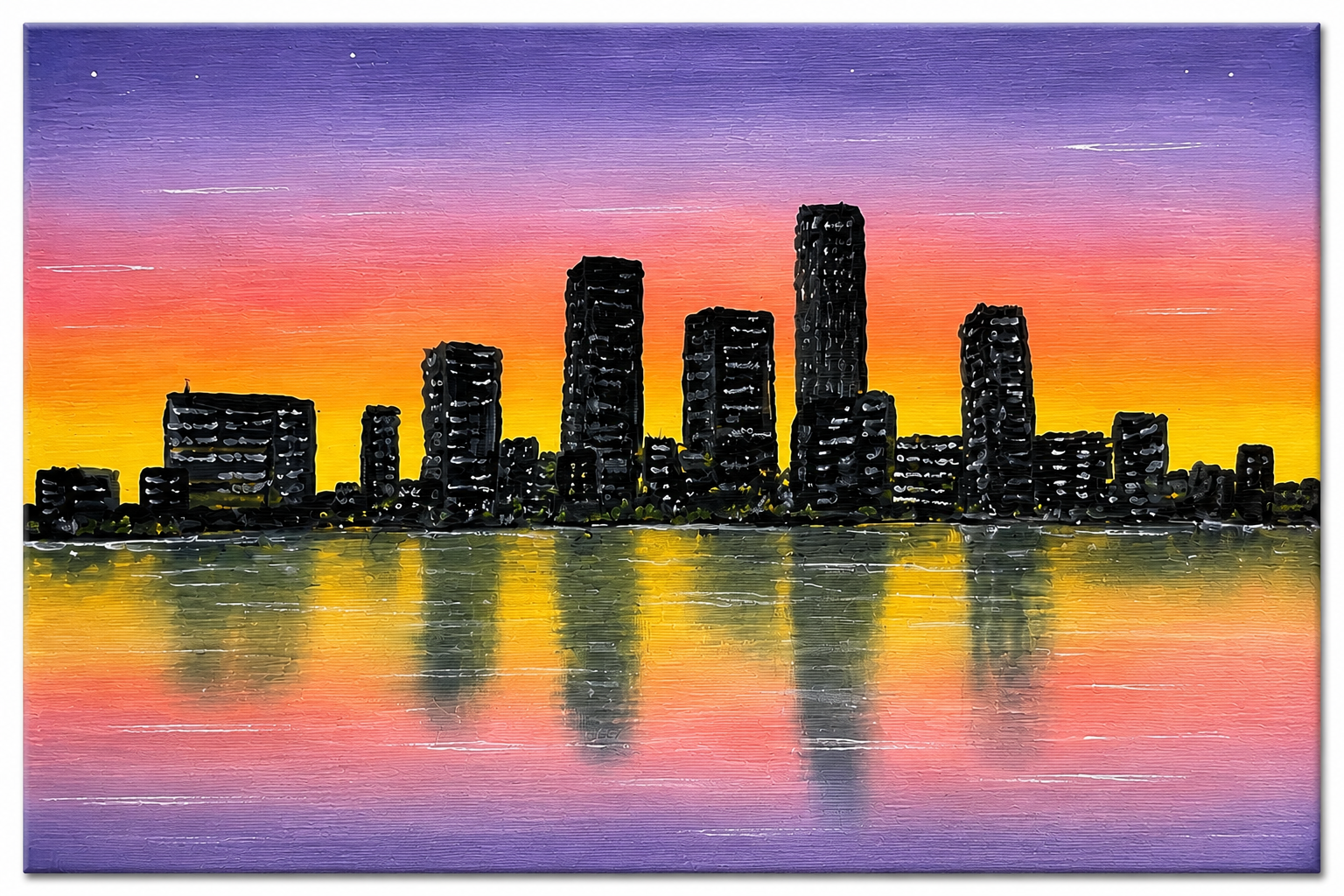
City of Light and Sound
Oil on Canvas | 10 × 20 in
Where the energy of the city meets the stillness of the water.
City of Light and Sound captures a city at the edge of evening, reflected across calm water beneath a vivid summer sunset. The skyline is bold and almost imposing, while the water below softens its presence, creating a quiet moment within an environment normally defined by movement, noise, and constant activity. Vincent intentionally plays with this contradiction—the city is loud, yet from this distance, everything feels still.
The vibrant palette draws from Vincent’s childhood memories of visiting New York during the summer: brilliant sunsets, humid air, and skyscrapers that seemed to blur and melt into the horizon. There is something nostalgic in that hazy atmosphere—the feeling of being hot and sweaty from the summer sun, waiting for the evening to finally cool, and watching the city transform as the sun goes down. Through its contrast of nature and architecture, movement and stillness, City of Light and Sound becomes less a portrait of a particular skyline and more a memory of what a city feels like when you stop long enough to simply watch it.
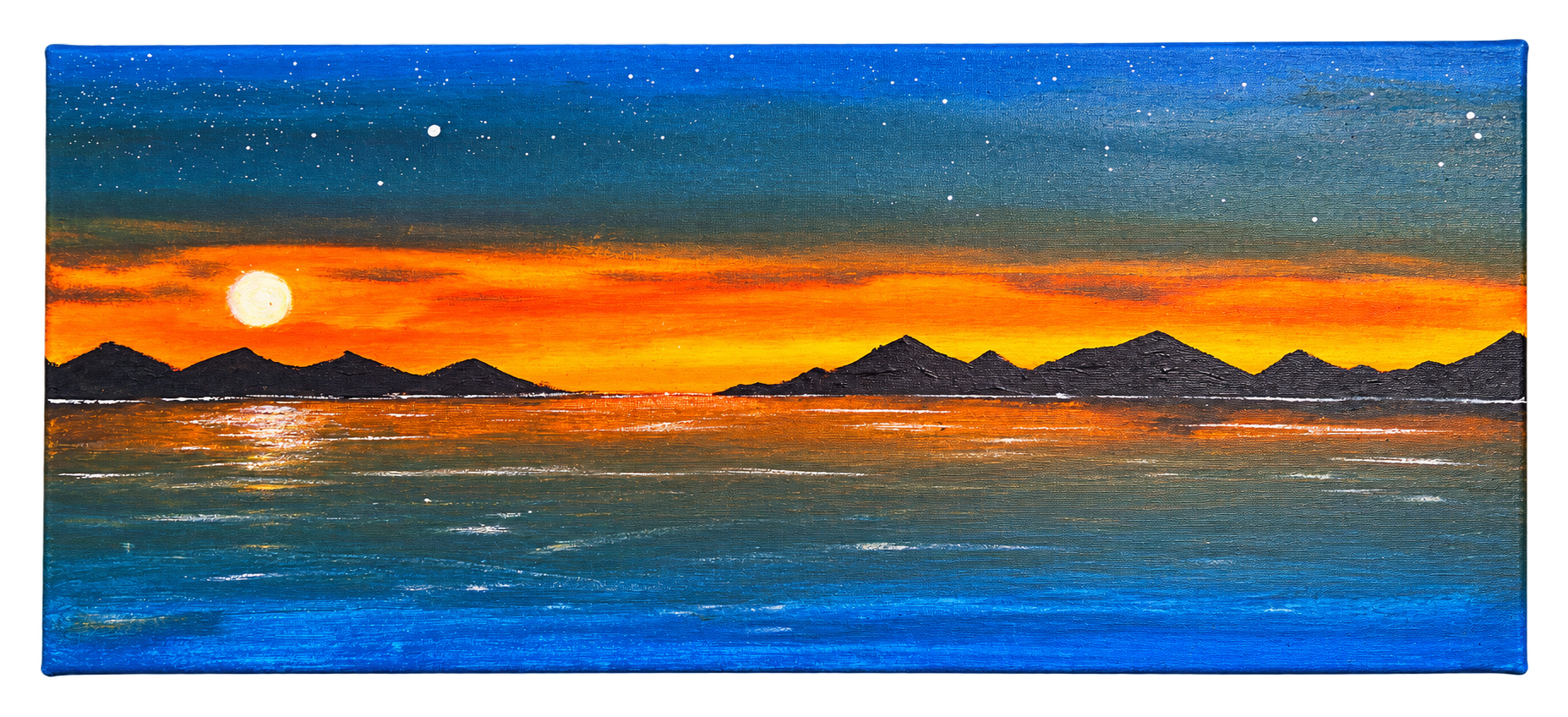
Date Night
Acrylic on Canvas | 10 × 20 in
A shared canvas, a summer sky, and a little mystery.
Date Night was created as a step-by-step paint-along between Vincent and Ashley, using the “Joy of Painting” method made famous by Bob Ross. More than simply recreating a landscape, the piece became a way for Vincent to share his love of painting, color, and the world he inhabits as an artist.
The contrasting blues, oranges, and deep silhouettes create a landscape that feels both mysterious and intimate. The colors stand apart from one another while somehow belonging together, much like the two people creating side by side. The tutorial was a success, but Ashley’s version of the painting remains a mystery—her canvas is hers alone, making this piece a small record of a shared experience that only the two of them fully know.
At its heart, Date Night is about the joy of painting together: stepping into someone else’s artistic world for an evening, following the same process and discovering where two different hands take the same idea.
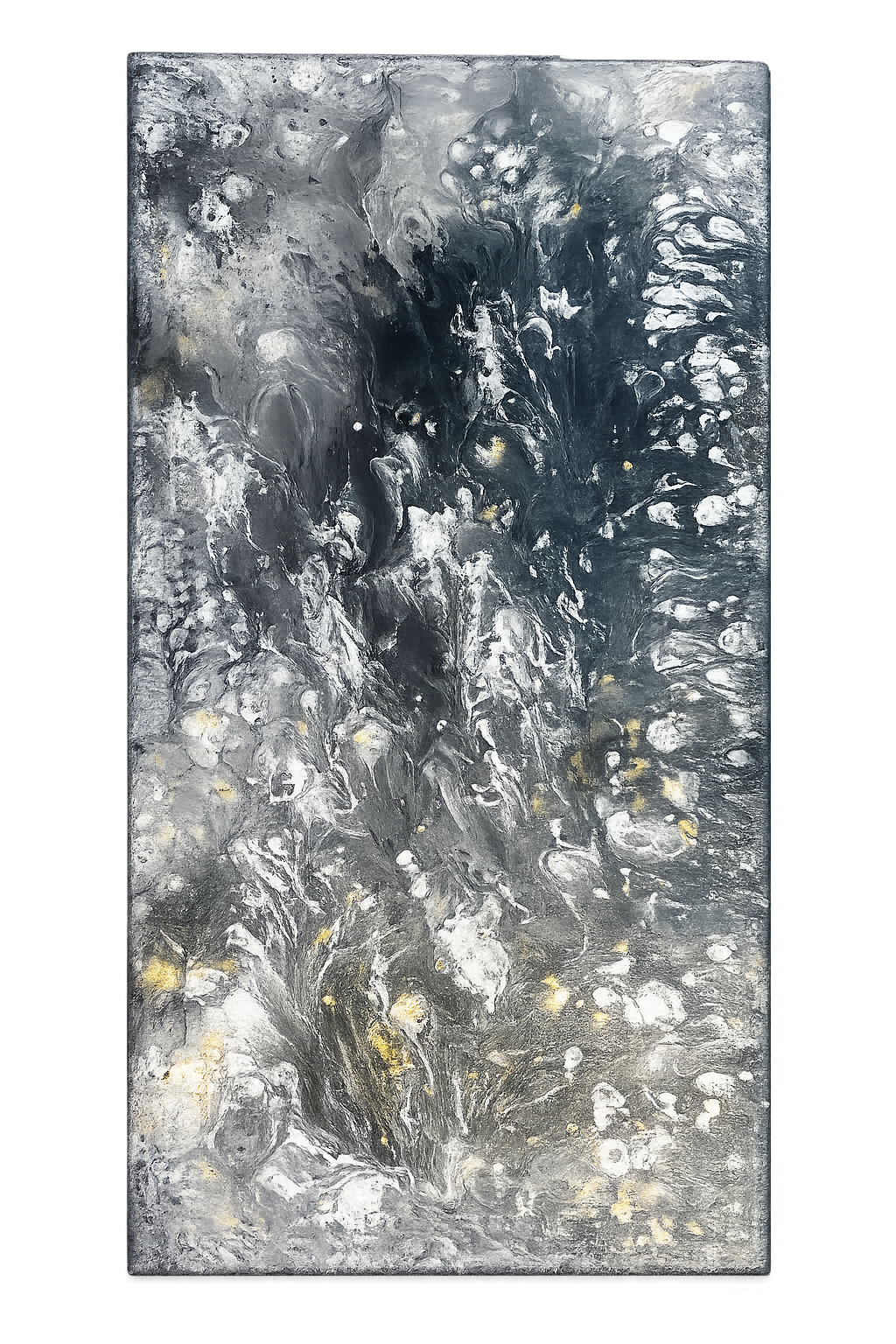
Soulhaven
Acrylic on Canvas | 20 × 10 in
A study in surrender, discovery, and finding purpose where none was planned.
Soulhaven began as an experiment in letting go. Created during Vincent’s early exploration of pouring and splatter techniques, the piece was intentionally made without rules, boundaries, or a predetermined image. The goal was simply to remove restriction, allow the paint to move freely, and see what emerged.
What emerged was unexpectedly evocative: a surface reminiscent of the moon, filled with ghostly, almost weightless forms that seem to drift through the composition without boundaries. The figures and textures feel suspended between the physical and the spiritual, giving the piece an otherworldly presence.
In that way, the painting became a reflection of its own creation. What began without direction gradually revealed a sense of purpose and meaning that could never have been planned. Soulhaven becomes a meditation on the journey of a soul on Earth—beginning without knowing where it is going, moving freely through the unknown, and ultimately discovering a purpose greater than what could have been imagined at the start.
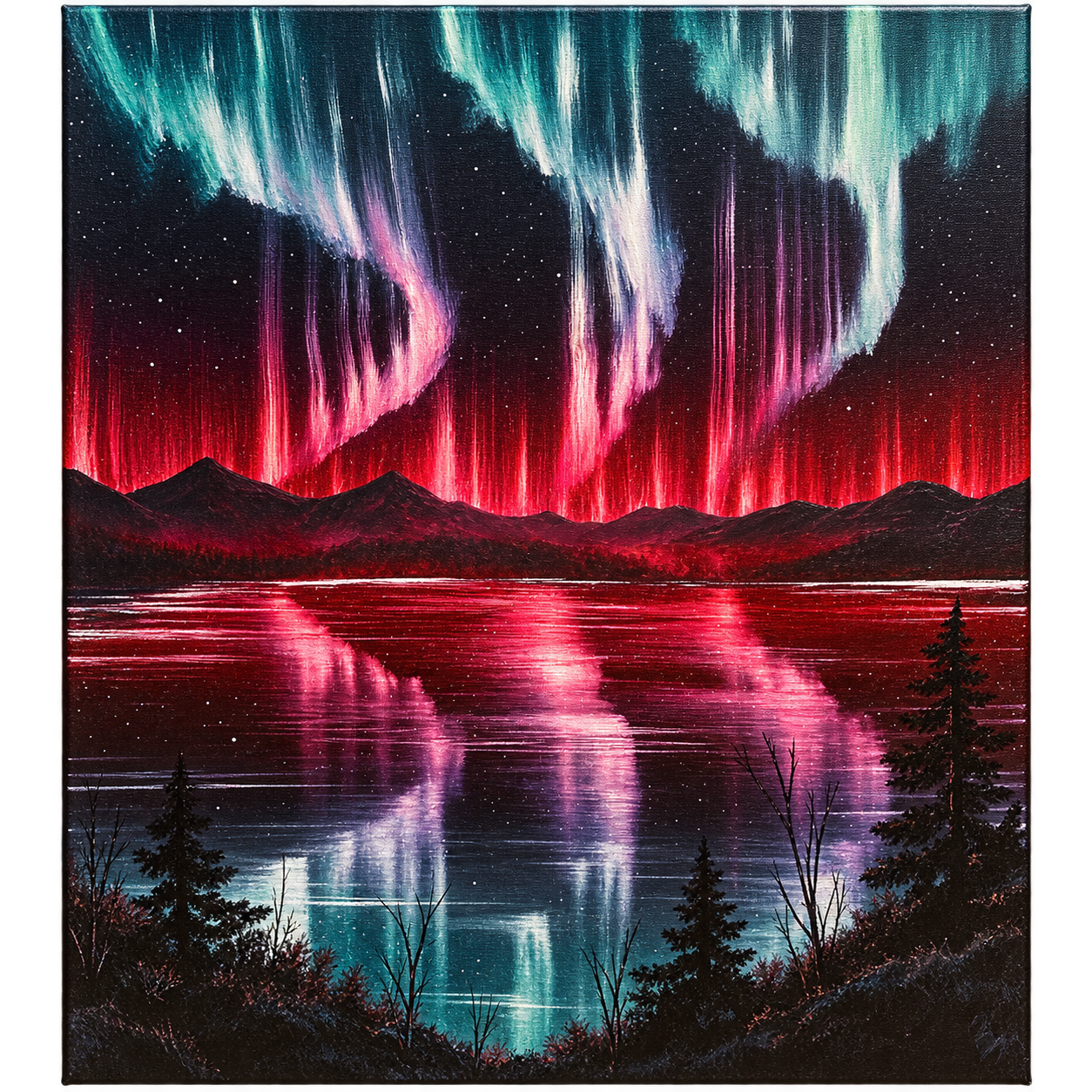
Mirrors
Oil on Canvas | 16 × 20 in
A reflection of the universe, reflected back to us.
Mirrors is an exploration of contrast, atmosphere, and the connection between Earth and the cosmos. Painted on a black canvas, Vincent intentionally departed from his usual approach of beginning with a lighter background, allowing the darkness to become part of the composition and heighten the intensity of the northern lights above the landscape.
The aurora stretches across the night sky in vivid teal, violet, and crimson, its colors reflected across the surface of a frozen lake below. The reflection creates a visual symmetry between sky and earth, blurring the boundary between the two. The result is a landscape that feels both familiar and otherworldly—like catching a glimpse of the universe within a single moment on Earth.
Mirrors is meant to evoke the awe of witnessing the aurora borealis in person: the feeling of standing beneath something vast and almost impossible to comprehend. In the reflection of the lake, the sky becomes part of the earth and the earth becomes part of the sky—a reminder that, in the end, they are one and the same.
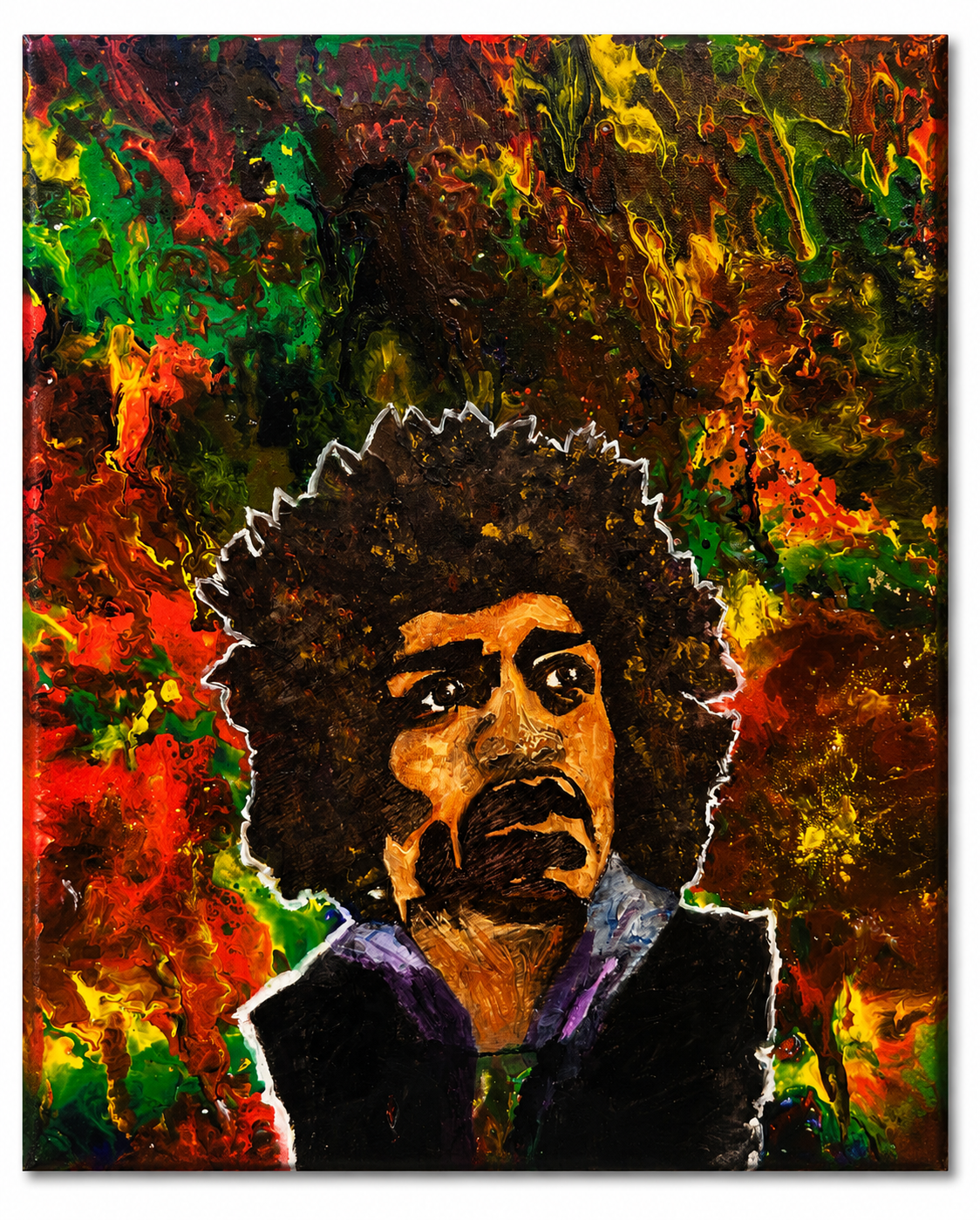
Hey Joe
Oil on Canvas | 16 × 20 in
An homage to the man, the myth, and an immortal sound.
Hey Joe is Vince’s psychedelic tribute to Jimi Hendrix, one of his all-time favorite musicians and an artist whose influence reshaped the sound of an era. Hendrix was an undeniable underdog who rose to become a legend, developing a style so unmistakably his own that his music continues to transcend the time in which he lived.
The vibrant, swirling colors surrounding Hendrix draw from the visual language of the 1960s and 70s, echoing the psychedelic rock movement, Woodstock, and the counterculture that helped define the era. Against this explosive backdrop, Hendrix appears almost as a figure emerging from the very movement he helped create—bold, unconventional, and entirely his own.
For Vince, the painting is both an appreciation of Hendrix’s immense talent and a reflection on a life that ended far too soon. Though he never had the opportunity to reach his full potential, Hendrix left behind a sound that became immortal. Hey Joe honors a simple man who changed music forever, and the enduring spirit of an artist who paved a path that few before or after him could replicate.
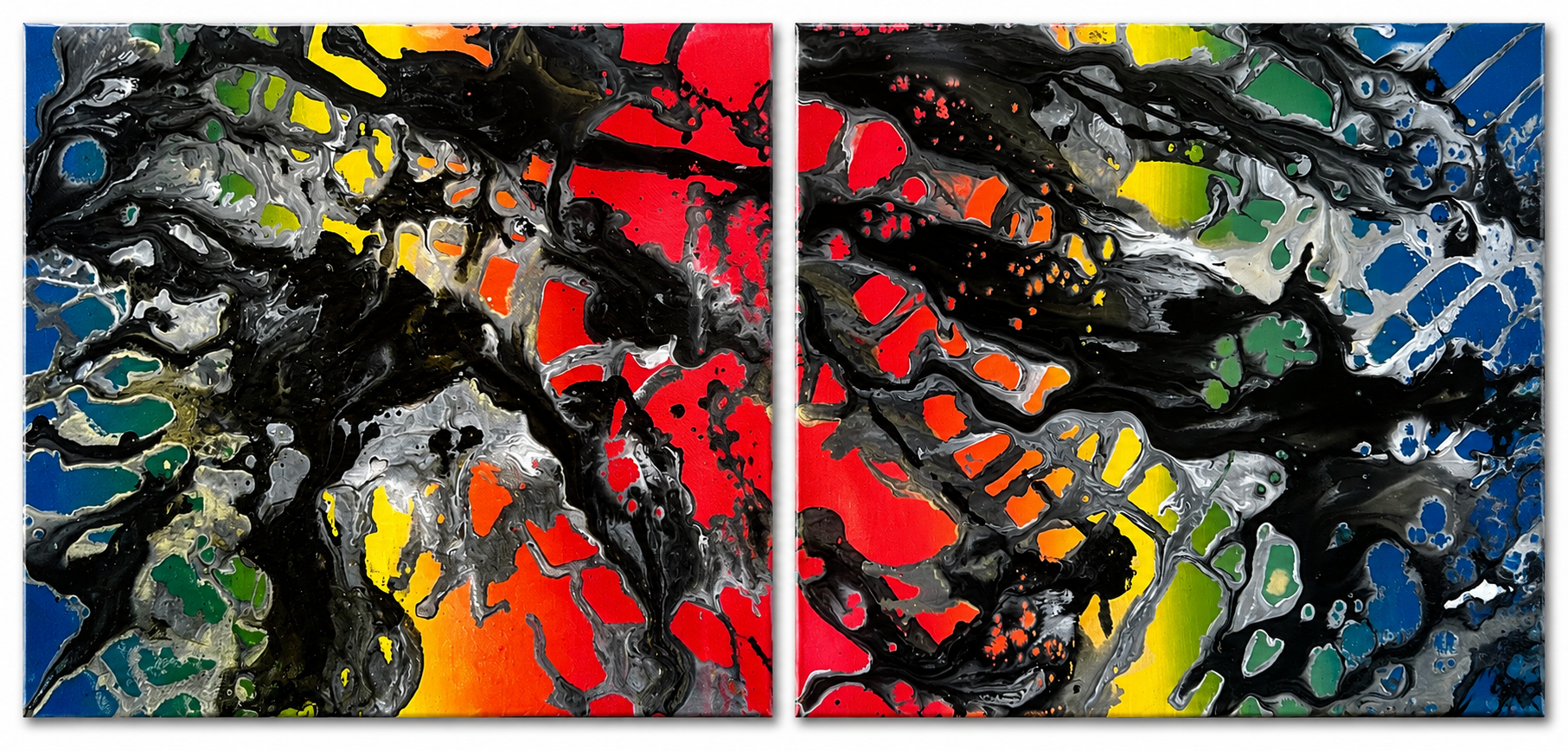
Chromascale
Diptych | Oil on Canvas | 12 × 12 in
A study in finding beauty between chaos and serenity.
Chromascale is a diptych built from two opposing worlds: one chromatic, one grayscale. The foundation is a smooth balance of color, while the pouring medium creates a tangled, almost spidery layer across the surface. This was Vincent’s first experience with pouring, a technique he discovered after feeling that something had always been missing from the abstract methods he had previously explored. Rather than trying to control every movement, he allowed the paint to move freely and become something of its own.
The contrast became more than a visual experiment. At the time, Vincent felt surrounded by a messy, unruly atmosphere while simultaneously trying to build something beautiful and stable underneath it. The colorful foundation represents that beauty—the things worth holding onto, the balance he wanted to create—while the dark, unpredictable forms above it reflect everything that felt tangled and out of his control.
Chromascale came from wanting those two things to exist together. It is about craving peace while living through disorder, and trying to find harmony when the transitions in life feel anything but smooth. What began as an experiment with paint ultimately became a reflection of an emotional landscape: a beautiful foundation carrying the weight of everything that was happening above it.
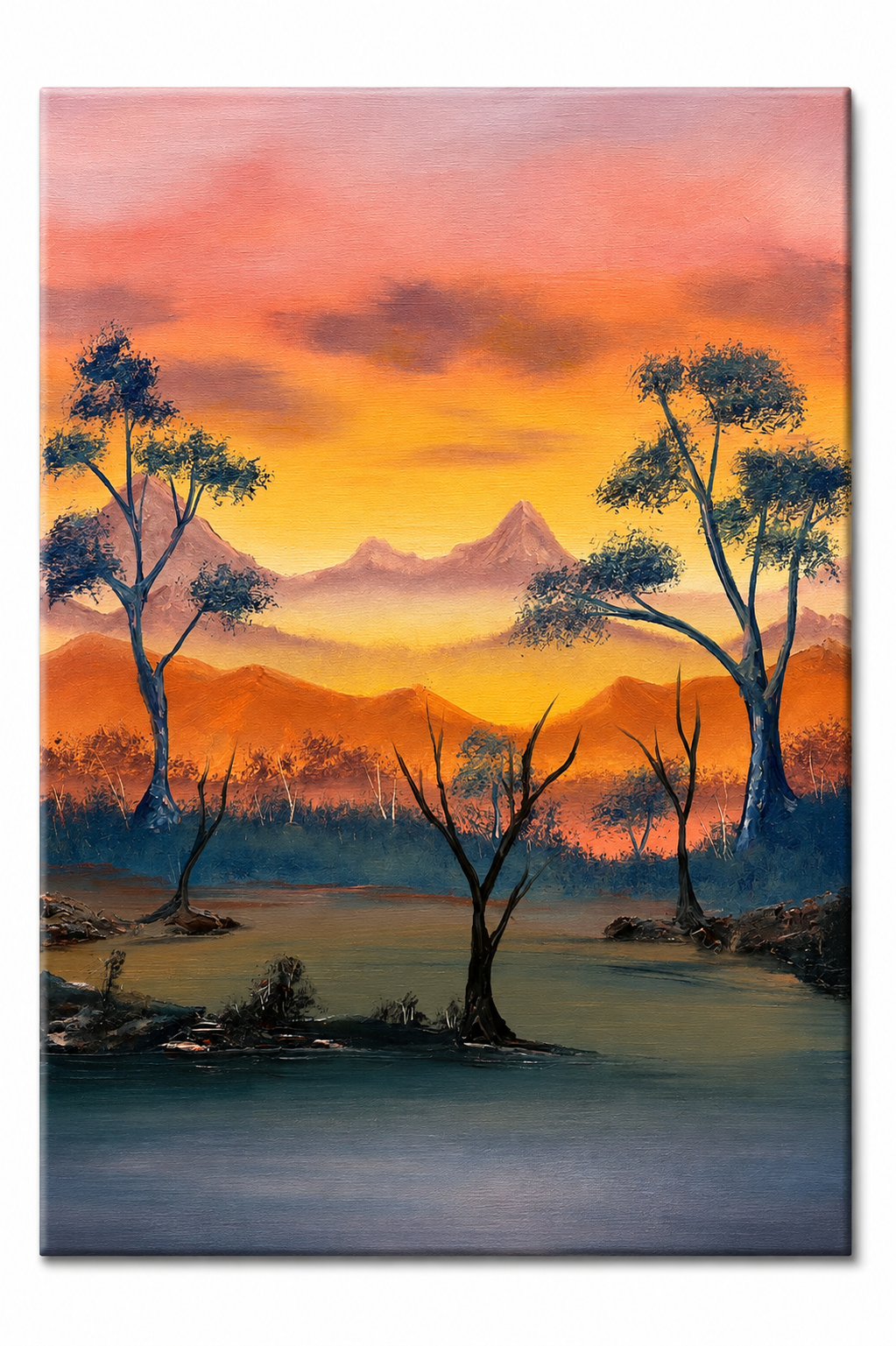
Remember Who You Are
Oil on Canvas | 16 × 20 in
Even in the bleakest places, something waits beyond the horizon.
Remember Who You Are marks Vincent’s return to the scenic landscapes that first became part of his artistic language, approached here with an entirely new palette. Inspired in part by the atmosphere of The Lion King, the title carries a deeper meaning—a reminder to return to what you know, trust your instincts, and remember who you are.
The landscape uses colors rarely associated with Vincent’s traditional scenic work, yet they come together to create something almost mystical: a distant, safari-like world suspended between warmth and isolation. The foreground feels quiet and desolate, with bare trees and muted shadows, while the mountains and glowing sky beyond them offer a sense of peace and possibility. That contrast is central to Vincent’s style—the meeting of light and dark, both visually and emotionally.
Remember Who You Are is ultimately a reflection on the coexistence of opposing feelings. A place can feel lonely and still hold wonder. A moment can feel bleak while something hopeful exists just beyond it. Sometimes the landscape changes simply because you learn to see it differently.
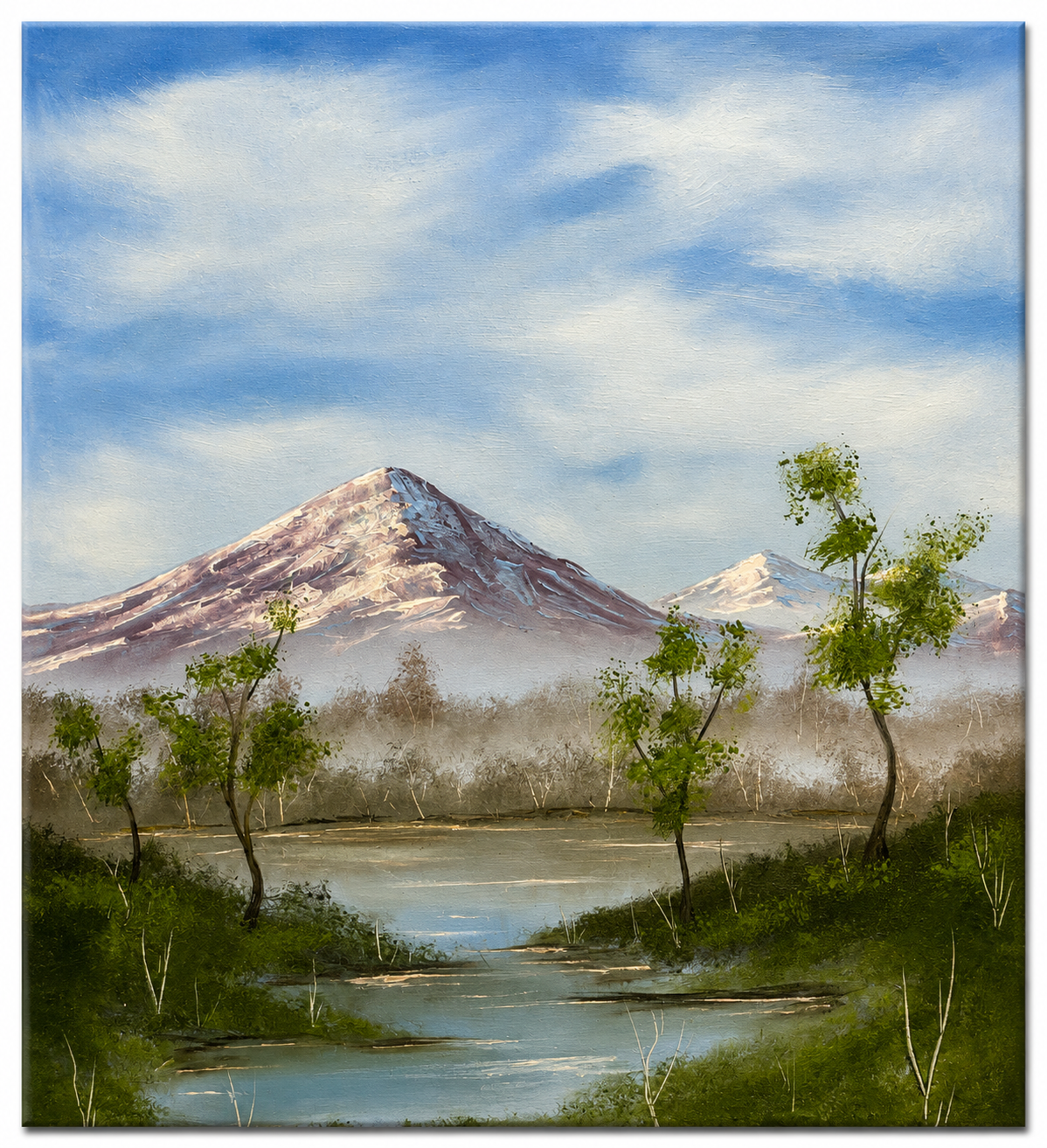
Mentor’s Mind
Oil on Canvas | 20 × 24 in
The wonder of creating a world through someone else’s eyes.
Mentor’s Mind is a return to Vincent’s most familiar artistic language: a classic mountain landscape, drifting clouds, quiet water, and a palette rooted in the traditional colors of scenic painting. After experimenting with different techniques and approaches, Vincent revisited the methods he had practiced countless times before, allowing the process itself to become the focus.
While painting, Vincent’s child watched from nearby, asking questions about each step and the purpose behind it. They weren’t following along with their own canvas; they were simply watching a world take shape. What might have felt like an ordinary painting process to Vincent became something entirely different through the curiosity of a young mind. Every brushstroke had a purpose, every color changed the scene, and every new layer revealed something that wasn’t there moments before.
There was something deeply familiar in that experience of teaching—a reminder that parenting often means rediscovering the wonder in things you have learned to do without thinking. In many ways, creating a landscape is not so different from the way a child creates entire worlds through imagination and play. Watching Vincent paint can feel a little like watching someone build a world in Minecraft: starting with almost nothing and slowly turning it into somewhere you can imagine yourself standing.
Mentor’s Mind became a reminder that Vincent often appreciates his art most when he sees it through someone else’s eyes. What he may understand as technique, process, and repetition can still feel like discovery to someone seeing it for the first time. In that moment, the painting became about more than the landscape—it became about sharing the wonder of creating something with a young person who was still learning how the world works.
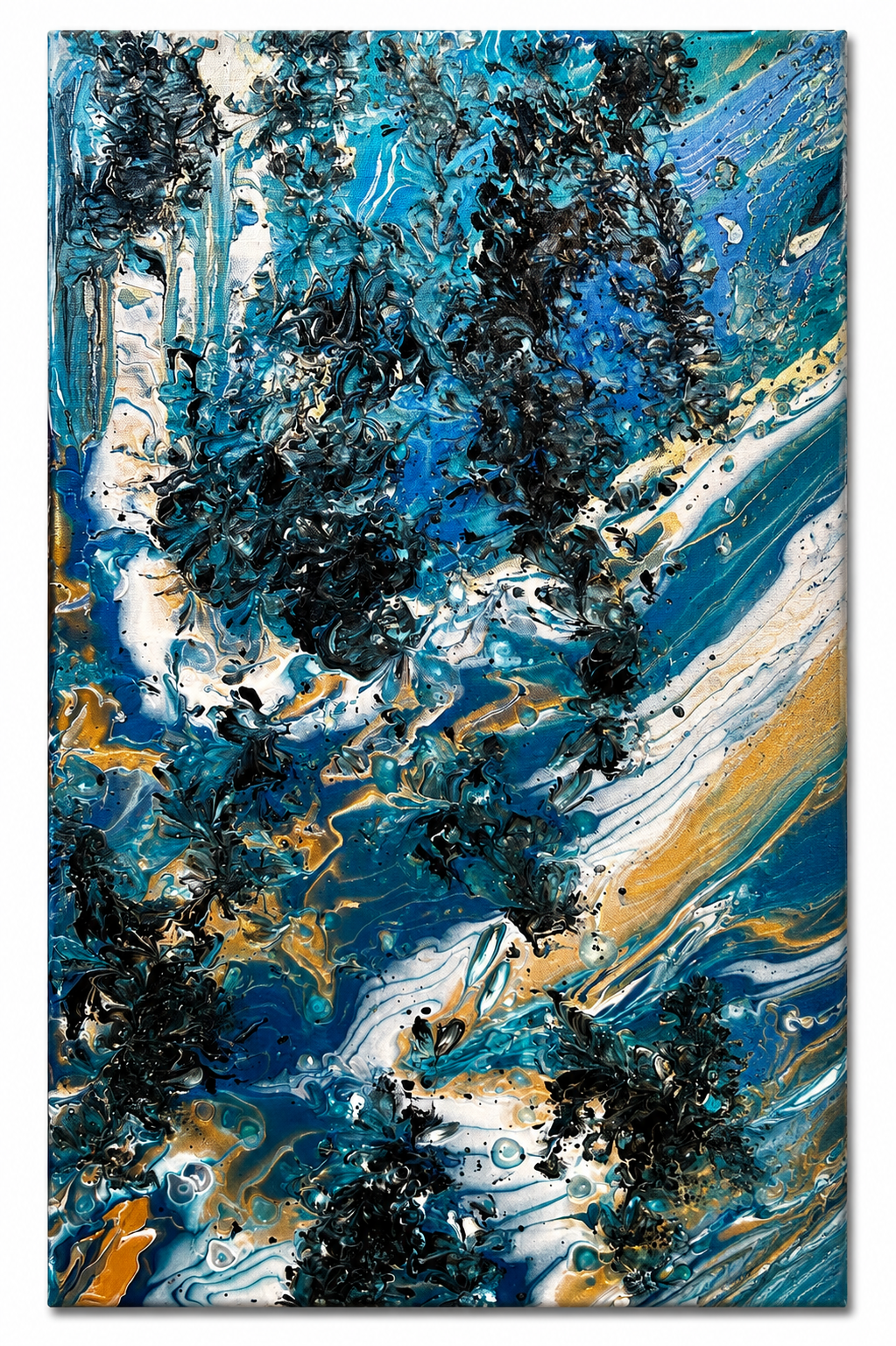
Tears of Gold and Steel
Pouring | Oil on Canvas | 12×24 in
Letting the paint decide where it wants to go.
Tears of Gold and Steel is an exploration of movement, gravity, and pure instinct. Created using the pouring technique Vincent continues to work with today, the piece began with three colors chosen for the way they could exist together without one overpowering the others. From there, the process was deliberately surrendered to the movement of the paint, allowing gravity and physics to determine how the colors would meet, separate, and ultimately become one composition.
There is no clear beginning or end between the colors. They flow into one another, creating forms that seem almost fluid enough to be melting, while gold and steel-like tones emerge and disappear throughout the surface. The effect is spontaneous and constantly shifting, inviting the eye to follow the movement rather than search for a single focal point.
The irony of the finished piece is in its appearance: painted on a particularly hot day, its flowing forms seem to carry the sensation of heat and melting, though the temperature had nothing to do with the process itself. That coincidence became part of the character of the work. Tears of Gold and Steel is ultimately about letting go—starting with a few simple elements, releasing control, and seeing what happens when the paint is allowed to speak for itself.
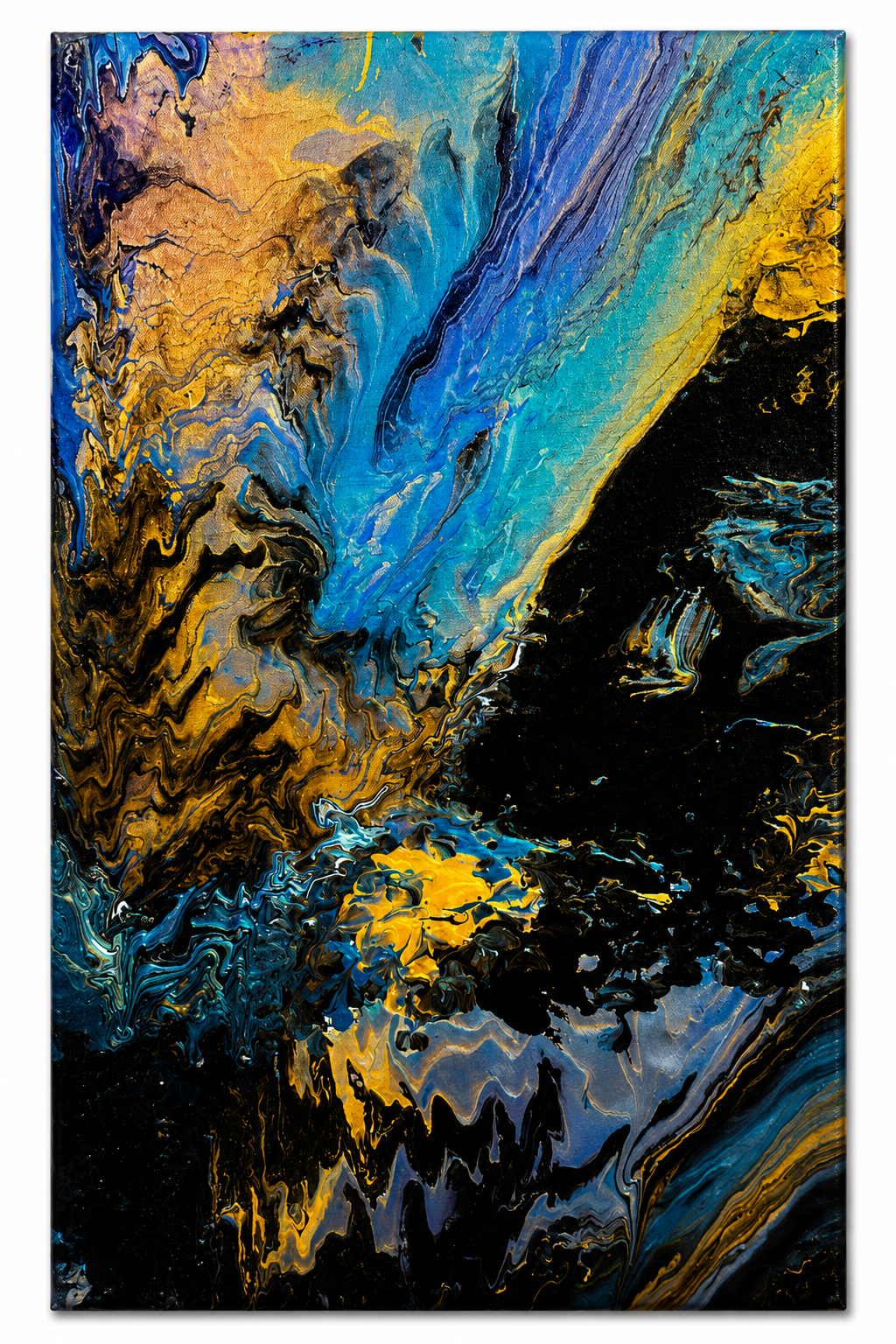
Rivers of Iridescence
Pouring | Oil on Canvas | 12×24 in
The same colors. A different story.
Rivers of Iridescence was created alongside Tears of Gold and Steel, using the exact same colors, medium, and pouring process. Yet where its companion became fluid and molten, this piece took on an entirely different character. The difference came down to the way the paint moved—the unpredictable interaction of gravity, physics, and the individual behavior of the colors as they met on the canvas.
The result is something almost mystifying, with sweeping bands and dark, fluid forms reminiscent of an oil spill catching light. Iridescent passages move across the surface in a way that seems to follow the viewer, creating the strange sensation that the painting is aware of the person standing in front of it. Rather than simply giving the eye somewhere to look, the work seems to look back.
There is also a quiet connection to the day it was created. While Tears of Gold and Steel seemed to embody the heat of the afternoon, Rivers of Iridescence feels like the brief relief of a passing breeze—the few seconds of refuge from an otherwise blistering day. Together, the two paintings became an unexpected study in how differently the same elements can behave when given the freedom to move on their own.
Of the two, Rivers of Iridescence remains Vincent’s proudest pouring to date. Its existence is a reminder that sometimes the smallest change in circumstance can create an entirely different outcome—and that two works can share the same beginning while becoming completely their own.
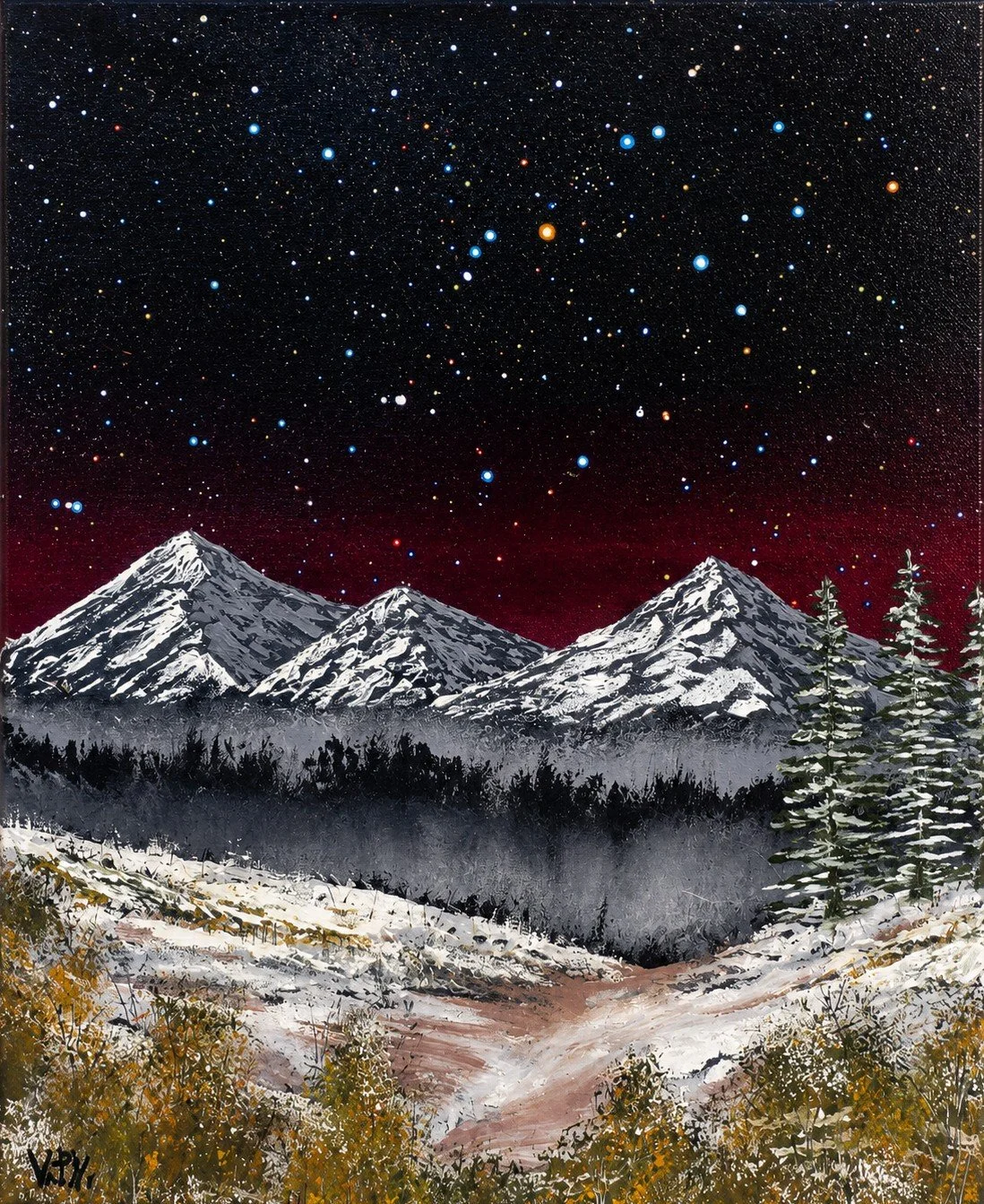
Orion
Oil on Canvas | 16 x 20 in
Beneath the hunter’s stars, the earth rests in frozen silence.
In Orion, Vince turns his attention to the quiet majesty of winter landscapes. Snow blankets the ground and clings to the jagged peaks of distant mountains, creating a scene defined by stillness and clarity. Above the landscape stretches a vast night sky filled with countless stars, their scattered lights piercing the deep darkness with delicate brilliance.
This work marks Vince’s first exploration of a snowy landscape, and the atmosphere reflects that experimentation. The cold tones of the snow and distant fog evoke the sharp quiet of winter nights, when sound seems to soften and the air itself feels suspended. Against this frozen terrain, the sky becomes the dominant force within the composition.
The title references Orion, one of the most recognizable constellations in the night sky. For thousands of years, Orion has held a place in mythology and navigation. In Greek mythology, Orion was the great hunter placed among the stars by the gods. Across cultures, the constellation has served as both a celestial guide and a symbol of endurance beneath the infinite night.
Vince’s interpretation places the viewer at ground level beneath this cosmic canopy. The snowy path in the foreground leads the eye toward the distant mountains, creating a quiet sense of journey or passage through the landscape. Meanwhile, the glowing stars above remind the viewer of the immense scale that stretches far beyond the earth itself.
The painting captures a paradox that often defines winter nights. The environment appears cold and silent, yet the sky above is alive with luminous energy. Through this contrast, Orion invites the viewer into a moment of solitude beneath the stars, where the stillness of the earth meets the endless movement of the cosmos.
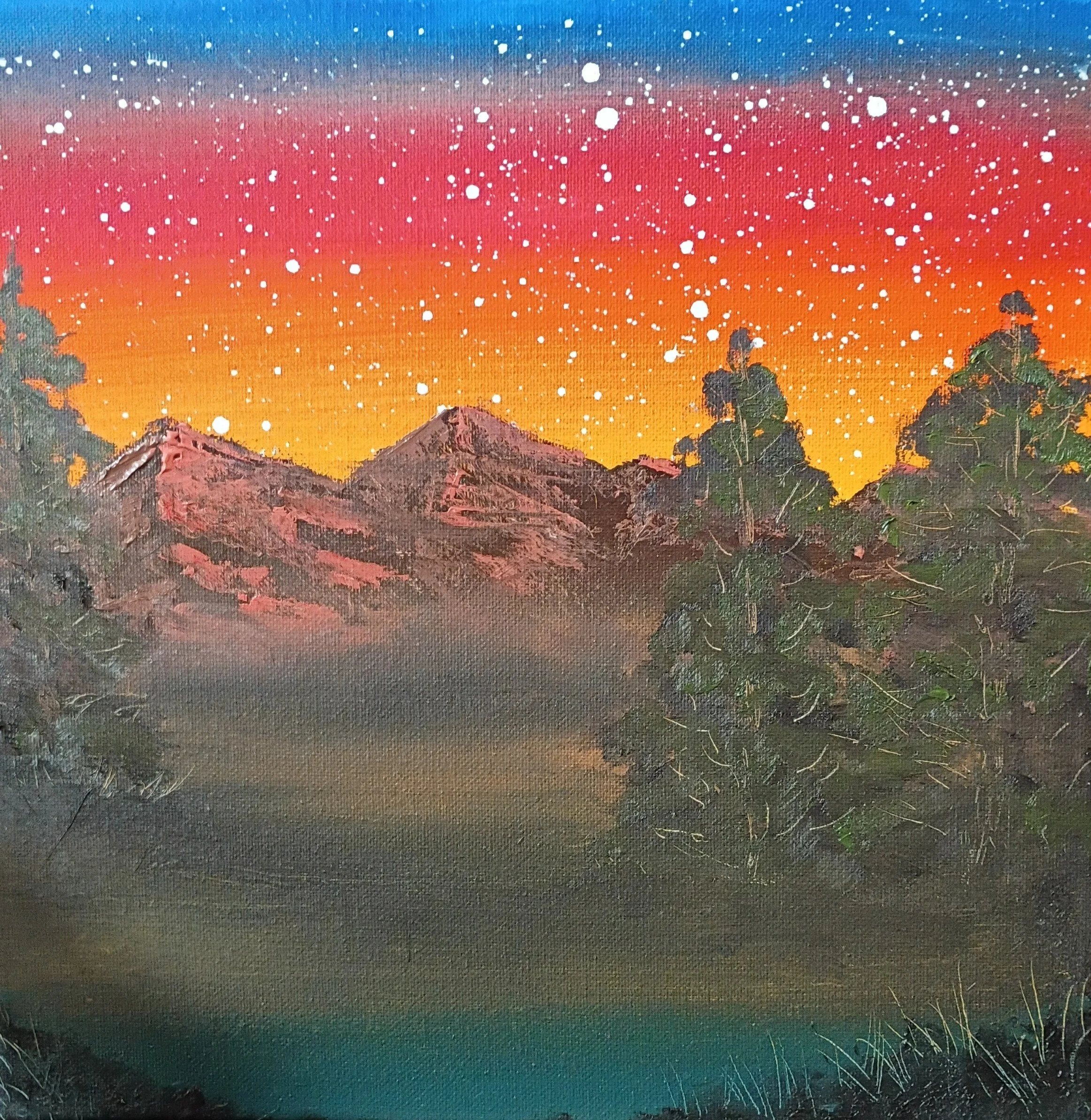
Revival
Oil on Canvas | 12 x 12 in
The moment when creativity returns and the horizon begins again.
In Revival, Vince captures a landscape that feels suspended between night and day, silence and awakening. Snow-touched mountains rise beneath a sky ablaze with warm tones of crimson, orange, and gold, while a constellation of white specks scatters across the upper atmosphere like falling stars or drifting snow. The sky becomes a meeting point of cosmic and earthly elements, creating a scene that feels both grounded in nature and lifted into something more symbolic.
The painting carries a deeply personal significance. After two years away from painting, Vince returned to the canvas with this work, marking the beginning of a renewed artistic chapter. The title reflects that moment of reawakening. Much like the natural cycles depicted in the landscape, creativity can recede into dormancy before emerging again with renewed energy.
The vibrant sky contrasts with the quiet stability of the mountains below. This visual tension mirrors the emotional experience of rediscovery. The stillness of the land suggests patience and endurance, while the explosive color of the sky signals movement, change, and the reappearance of creative momentum.
Throughout art history, skies have often been used to symbolize transformation and rebirth. The rising light behind the mountains in Revival echoes this tradition. Though the sun itself remains unseen, its presence is unmistakable in the glow that spreads across the horizon and reflects onto the mountain ridges.
In this way, Revival becomes more than a landscape. It is a declaration of return. The mountains remain where they have always been, but the light has come back. Through color, atmosphere, and renewed intention, Vince transforms the scene into a quiet celebration of beginning again.
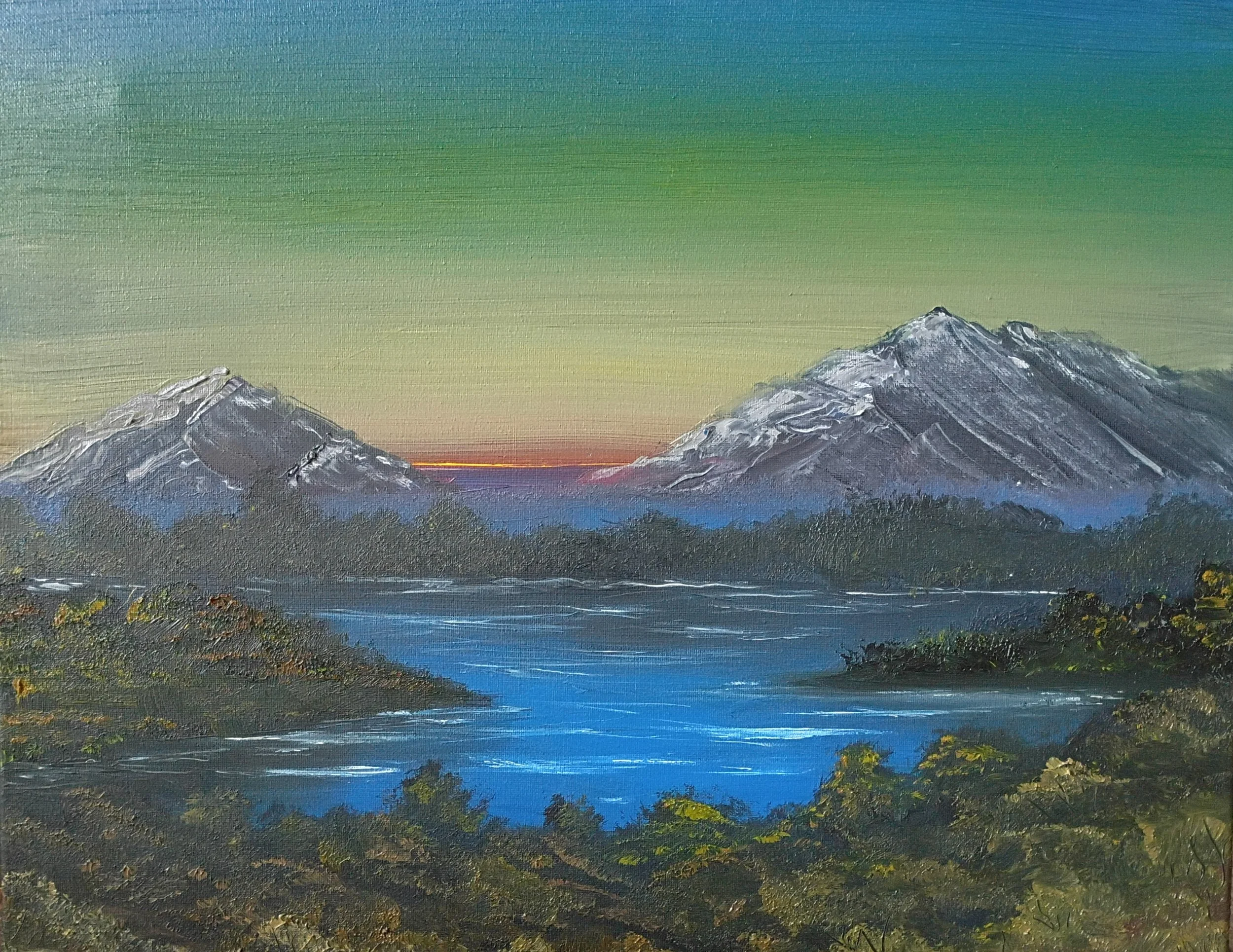
Dawn
Oil on Canvas | 20 x 16 in
The first light that transforms everything it touches.
In Dawn, Vince continues his exploration of painting on a black canvas, allowing light to emerge gradually from darkness. Two snow-covered mountains frame a distant horizon where a narrow line of sunlight breaks through the landscape. Though small within the composition, this thin band of light becomes the focal point of the entire scene, illuminating the surrounding water, forests, and sky with subtle shifts in color.
The painting reflects Vince’s fascination with how light shapes the natural world. Throughout the composition, darkness forms the structural foundation while light acts as the defining force that gives life to the landscape. The glowing horizon casts delicate reflections across the water and gently lifts the cool tones of the sky above, demonstrating how even the smallest presence of sunlight can alter the entire atmosphere of a scene.
Historically, dawn has often symbolized renewal, awakening, and the promise of possibility. In literature and art, the moment when night begins to surrender to morning has been used as a metaphor for transformation and realization. Here, Vince captures that threshold. The mountains remain grounded and steady, while the rising light introduces movement and quiet optimism into the landscape.
The composition also reflects a personal milestone in Vince’s development as a painter. The work carries the feeling of discovery, a moment when experimentation with technique and light revealed a sense of confidence and direction. The subtle horizon glow serves as both a literal sunrise and a symbolic one, representing a point where the artist felt a growing certainty in his craft.
Through the contrast of shadow and illumination, Dawn becomes a meditation on the power of small beginnings. A single sliver of sunlight stretches across the horizon, yet its presence transforms the entire world around it.
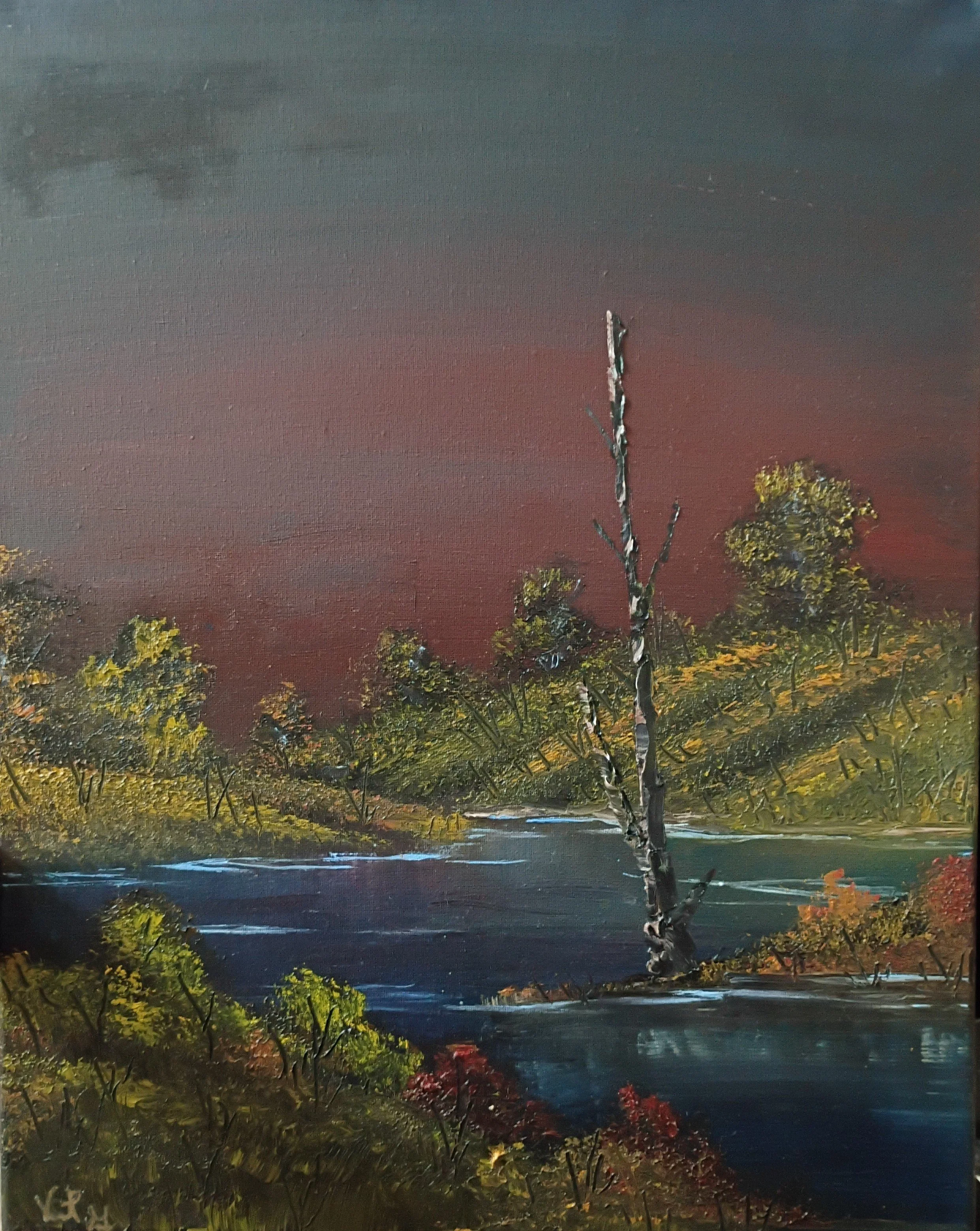
Der Sommer der Vampire
Oil on Canvas | 16 x 20 in
A summer landscape where tranquility and shadow coexist.
In Der Sommer der Vampire, Vince experiments with the dramatic possibilities of painting on a black canvas, allowing darkness to serve not as background but as the foundation of the entire composition. Emerging from this dark surface, a quiet lakeside scene unfolds. Soft reflections ripple across the water while illuminated trees rise from the shoreline, their foliage catching the last traces of fading light beneath a deep crimson sky.
This painting represents Vince’s first exploration of an inverted painting technique. Rather than building darkness over light, Vince reverses the process, allowing light to emerge from shadow. The result is a landscape that feels almost nocturnal in atmosphere, as if the scene exists in the final moments between sunset and nightfall. The glowing reds of the sky contrast with the cool blues of the water, producing a sense of tension between warmth and stillness.
The title, Der Sommer der Vampire or The Summer of the Vampires, introduces a subtle mythic dimension to the work. Throughout European folklore, twilight has long been associated with the boundary between the visible world and the unseen. It is the hour when shadows lengthen and imagination begins to fill the spaces left by fading daylight. The darkened sky and solitary tree rising from the water create an atmosphere that feels both serene and slightly uncanny.
At the center of the composition stands a stark, weathered tree reaching upward from the water. Its bare form contrasts with the surrounding vegetation, acting almost like a silent monument within the landscape. In many artistic traditions, solitary trees have symbolized endurance, isolation, or the passage of time. Here, the tree seems suspended between life and decay, mirroring the painting’s balance between beauty and darkness.
Through the use of a dark ground and carefully placed highlights, Vince transforms what might otherwise be a peaceful summer scene into something more introspective. Der Sommer der Vampire captures a moment where tranquility and shadow coexist, reminding the viewer that even the calmest landscapes often hold deeper, more mysterious undertones.
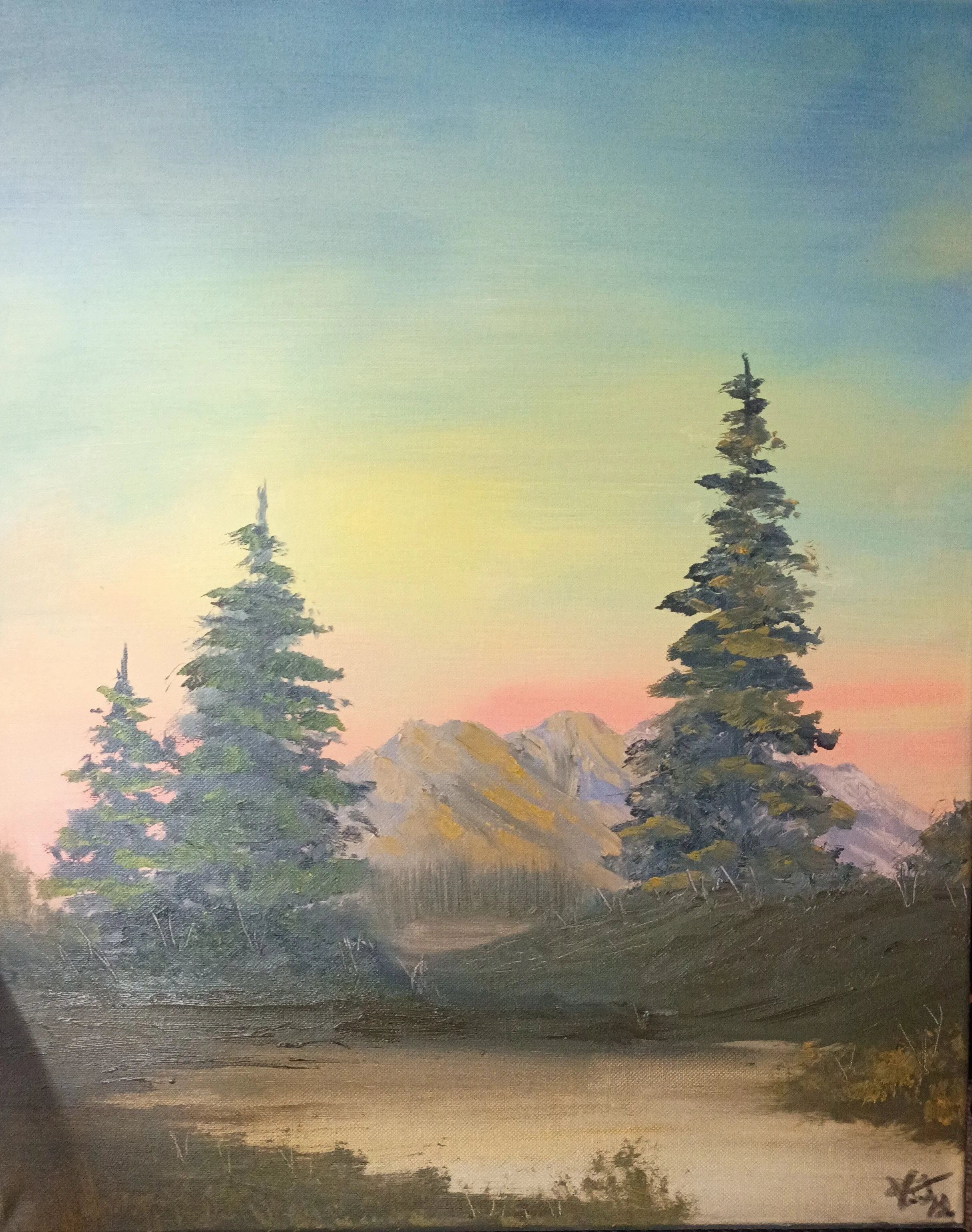
Sunset's Weight
Oil on Canvas | 16 x 20 in
The quiet gravity of evening settling across the mountains.
In Sunset's Weight, Vincent explores the delicate balance between light and shadow, using a mountainscape to study how atmosphere transforms the natural world. Tall evergreens stand in the foreground like silent witnesses, while distant peaks catch the final warmth of the fading sun. The sky transitions gently through soft blues, pale greens, and warm coral tones, suggesting the fleeting moment when daylight begins to surrender to night.
Vincent approached this painting as an exercise in contrast and depth. By carefully balancing darker foreground elements with luminous background light, the landscape develops a layered sense of distance. The viewer’s eye moves gradually from the quiet ground in the foreground, through the tree line, and into the softened mountains beyond. This technique echoes long traditions in landscape painting where atmospheric perspective is used to create the illusion of vast space within a flat surface.
The work also reflects Vincent’s exploration of seasonal atmosphere. The warm glow touching the mountain ridges suggests late summer or early autumn, a transitional moment when the landscape itself seems to hold a certain stillness. Across art history, sunset has often symbolized both closure and reflection. The end of a day carries with it a quiet weight, a sense that the world pauses briefly before darkness settles in.
In this painting, the sky becomes the emotional center of the scene. The gentle shift of color across the horizon creates a calm but powerful presence, almost as if the light itself presses softly against the land below. Through subtle color combinations and careful control of light and shadow, Vincent captures a moment where time feels suspended between day and night.
Sunset's Weight ultimately becomes a meditation on balance. Light against dark. Distance against closeness. Movement against stillness. Within that balance, the landscape holds a quiet gravity that invites the viewer to linger in the fading light.
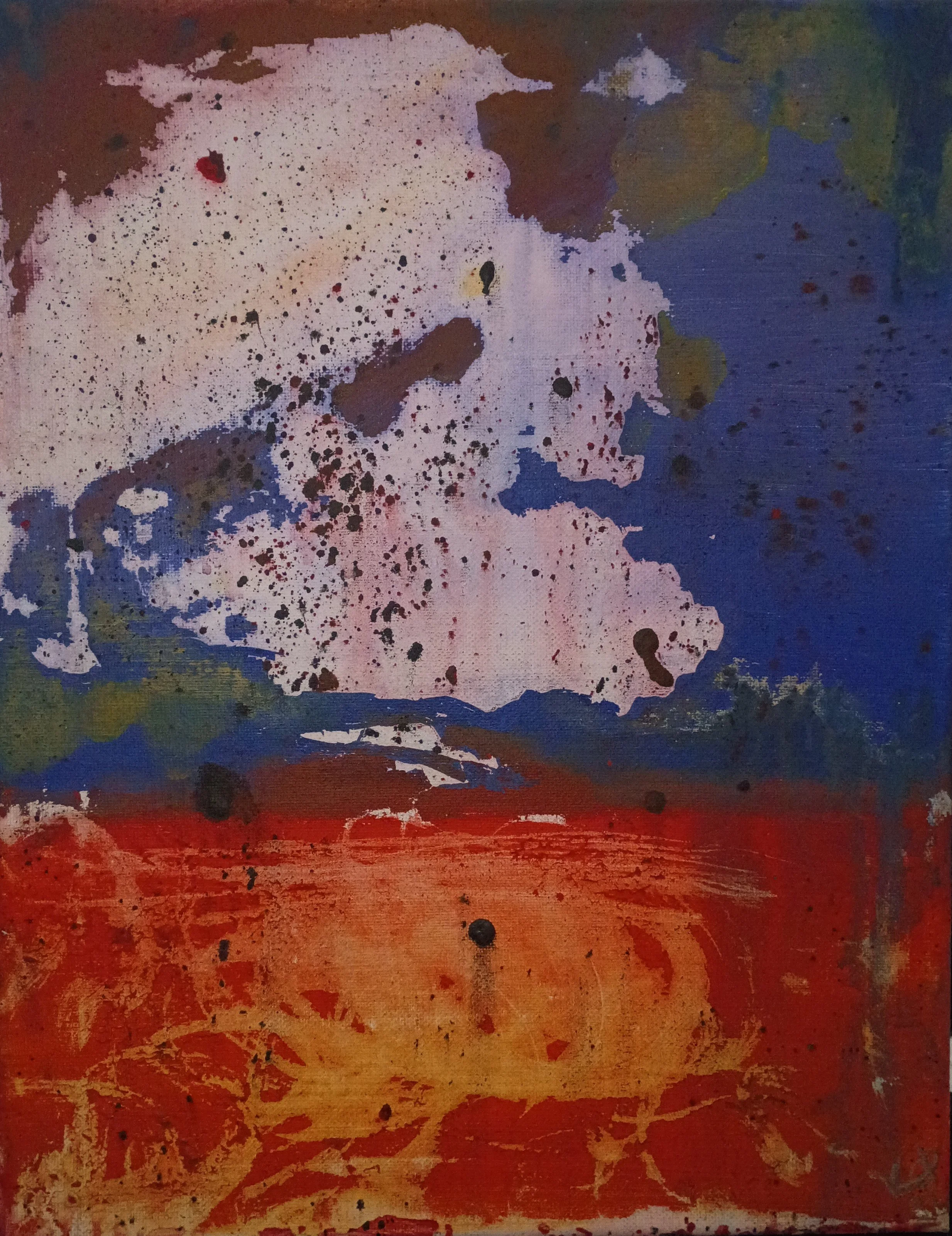
Hell on Earth
Acrylic on Canvas | 11 × 14 in
Where continents float above the quiet violence beneath the world.
In Hell on Earth, abstraction becomes cartography of the subconscious. What began as a spontaneous exercise in color and movement gradually revealed the suggestion of continents suspended above a volatile underworld. The upper portion of the canvas evokes the pale, fractured shapes of landmasses drifting across deep blue oceans, while the lower half erupts in molten reds and scorched oranges, resembling a sea of lava churning beneath the surface of the world.
This accidental emergence of geography recalls a long artistic tradition in which painters discovered landscapes within abstraction echoing the surreal tendency to allow forms to appear organically rather than be strictly imposed. Historically, humanity has imagined the Earth itself as layered between heavens and infernos: from the Greek concept of Tartarus beneath the mortal world, to medieval cosmologies depicting hell as a fiery abyss beneath the continents of the living.
The painting captures that ancient duality. Above lies the illusion of order, the calm blues of oceans and recognizable shapes of land. Below simmers chaos, rendered through aggressive textures and heated pigments that seem to glow from within the canvas itself. The scattered splatters across the central divide resemble falling ash or celestial debris, blurring the boundary between surface and underworld.
Vince’s second exploration into abstract technique reveals how play can lead to revelation. By relinquishing strict intention, the composition allowed an unexpected narrative to surface: a vision of the planet balanced precariously between stability and catastrophe. In this sense, Hell on Earth becomes more than a landscape, it is an allegory for the fragile equilibrium of existence itself, where beneath every ordered system lies the potential for eruption.
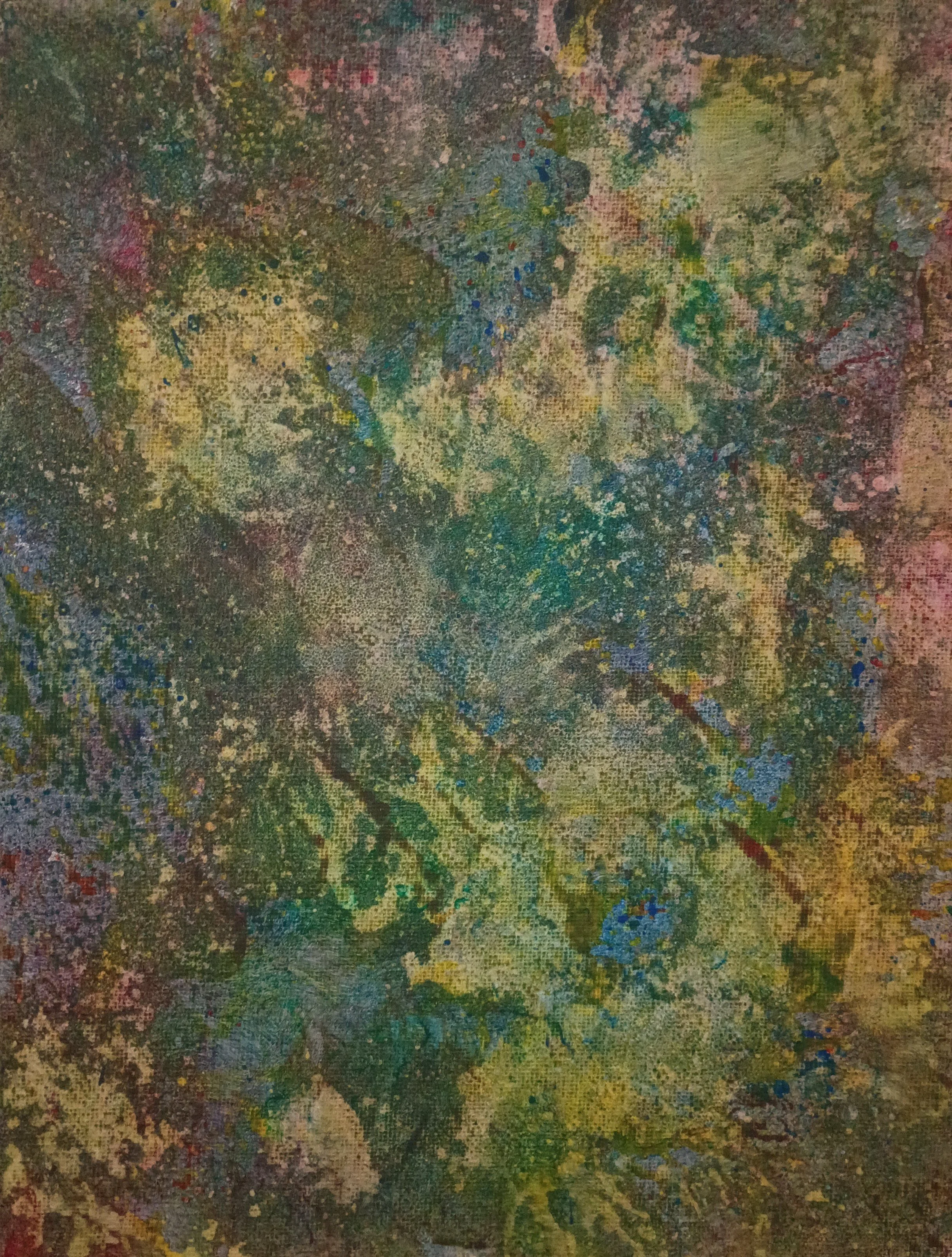
Marble Infection
Acrylic on Canvas | 9 × 12 in
Where permanence meets decay, and stone remembers it was once alive.
At first glance, Marble Infection evokes the mineral depth of ancient stone, its mottled greens, muted golds, and fractured blues recalling the veins of marble quarried since antiquity for temples, monuments, and tombs. Yet unlike the permanence of classical marble, the surface here feels unstable, as though the material itself is alive and undergoing transformation. The painting’s organic splatters and spreading pigments resemble biological growth, suggesting an unseen force slowly permeating the canvas.
Vince’s first exploration into abstraction embraces spontaneity rather than control. The composition emerges through layered pigments and chance interactions, echoing artistic movements such as Abstract Expressionism, where artists like Jackson Pollock and Helen Frankenthaler allowed gesture, gravity, and fluidity to become collaborators in the creative process. In this sense, the work becomes less about depicting a scene and more about revealing a process, creation unfolding in real time.
The title Marble Infection introduces a compelling tension between permanence and decay. Marble, historically associated with endurance and immortality, from the sculptures of ancient Greece to the cathedrals of the Renaissance, is here imagined as something vulnerable, capable of contamination. The artist draws inspiration from the fictional cordyceps infection depicted in The Last of Us, a fungus that overtakes its host, spreading silently beneath the surface before erupting into visible transformation.
Within the painting, the creeping greens and branching forms suggest a kind of microscopic landscape: part geological, part biological. It becomes difficult to determine whether the viewer is observing the slow formation of stone over millennia or the rapid colonization of an organism. This ambiguity invites a broader reflection on the cycles of nature: growth and decay, order and entropy, creation and corruption.
Ultimately, Marble Infection captures a moment of artistic liberation. By relinquishing strict control and allowing color and movement to guide the work, the artist mirrors the very phenomenon the painting evokes, an organic process spreading across the surface. What begins as an experiment becomes an allegory for transformation itself, reminding us that even the most solid structures, stone, systems, or certainty are never entirely immune to change.
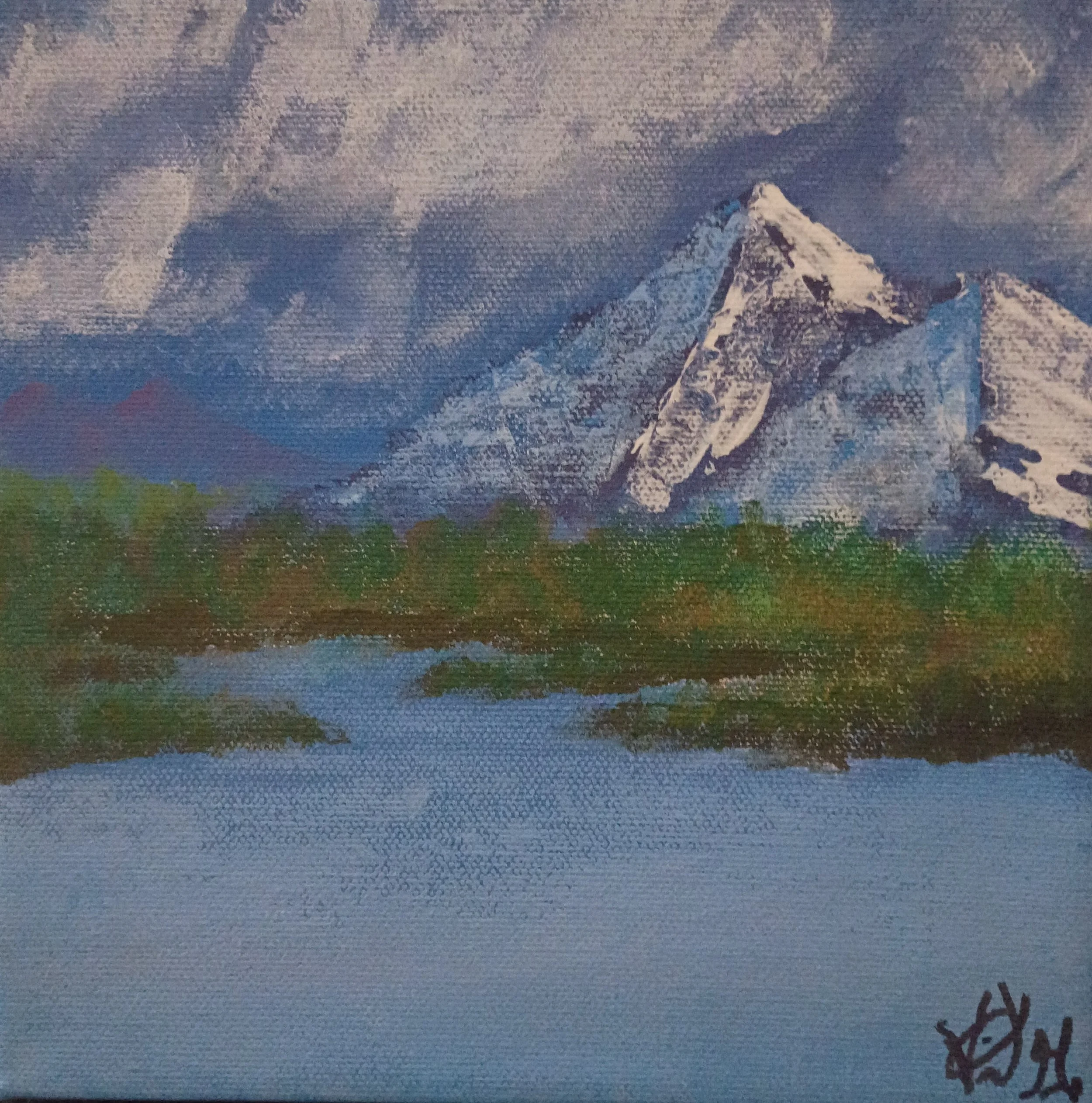
Blue and White
Acrylic on Canvas | 8 x 8 in | 1.5 in depth
A study in stillness where scale is reduced but presence remains immense.
In Blue and White, Vince turns toward simplicity as both method and philosophy. A solitary mountain rises beneath a clouded sky, its snow-covered face catching pale light while a quiet body of water rests in the foreground. The composition is restrained, built primarily from cool tones that evoke clarity, distance, and calm.
The work was created during a period when Vince was particularly drawn to mountainous landscapes. Rather than attempting to capture the overwhelming scale these environments typically possess, Vince chose to miniaturize the subject, compressing the vastness of alpine terrain into an intimate format. This reduction in scale invites the viewer to approach the mountain not as an unreachable monument but as something contemplative and accessible.
Mountains have long carried symbolic weight in art and philosophy. Across cultures they represent permanence, transcendence, and the human desire to reach something higher than the ordinary world. In classical Chinese landscape painting, mountains often appear as places where the earthly and spiritual worlds meet. In Western traditions they have been portrayed as sublime forces that remind humanity of both nature’s beauty and its indifference.
Here, however, the mountain feels quiet rather than imposing. The softened textures of the clouds and the stillness of the water temper the dramatic potential of the landscape. By limiting the palette and embracing simplicity, Vince allows the scene to exist in a quiet balance. The sky, water, and land settle into a calm harmony.
Blue and White ultimately functions as a meditation on restraint. By choosing a modest scale and minimal composition, Vince demonstrates how even the most monumental subjects can be expressed through subtlety. The result is a landscape that invites stillness, asking the viewer not to be overwhelmed by the mountain but simply to sit with it.
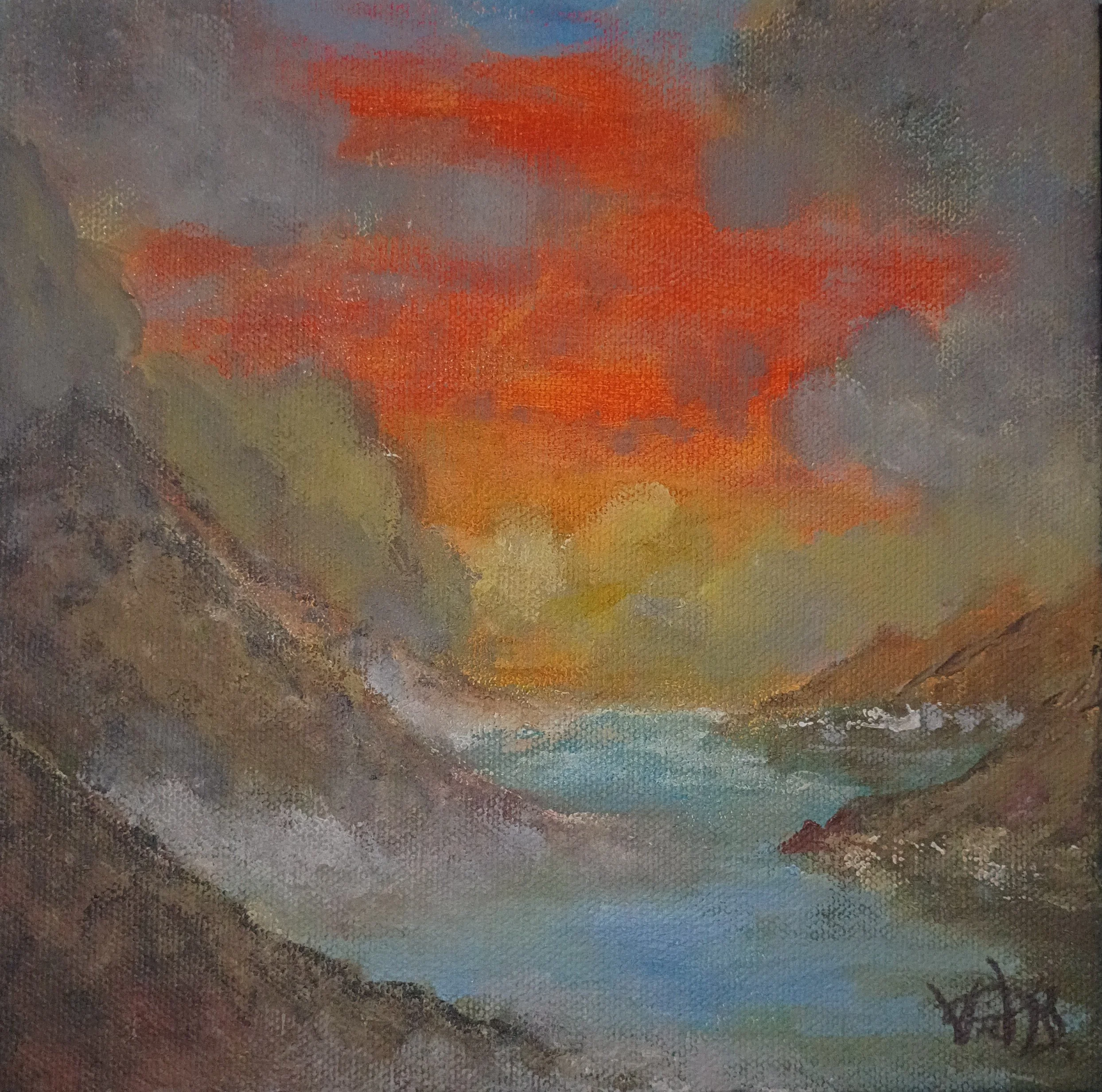
Domingo
Acrylic on Canvas | 8 x 8 in | 1.5 in depth
A quiet refuge where calm surfaces conceal an inner storm.
One of the artist’s earliest works, Domingo stands as a deeply personal landscape shaped as much by emotional memory as by paint. A winding body of water cuts through rugged hills beneath a sky glowing with intense orange and muted gold, creating a scene that feels both tranquil and unsettled at once. The composition suggests a secluded valley at sunset, a place that appears peaceful from a distance yet carries a subtle tension within its atmosphere.
The title itself evokes the Spanish word for Sunday, a day historically associated with rest, reflection, and spiritual pause. Across many cultures, Sunday has symbolized a moment of stillness between cycles of labor and obligation. In this context, the landscape becomes symbolic of that fragile stillness. The calm surface of the water and the softened hills represent the outward search for peace, while the restless sky hints at something more turbulent unfolding beneath the surface.
Vince approached this painting with an instinctive use of color, allowing pigments to move across the canvas without strict control. This intuitive process mirrors traditions in landscape painting where emotional state often guides the palette as much as observation of nature. Artists throughout history have used landscape not merely to depict terrain but to reflect inner psychological states. The valley in Domingo becomes less a physical place and more an emotional terrain.
The result is a work that embodies contradiction. Serenity and disorder coexist within the same frame. The landscape appears calm enough to rest within, yet the sky burns with a quiet intensity that refuses to fully settle. In this way, Domingo captures a universal experience of human life: the attempt to maintain composure outwardly while navigating chaos within.
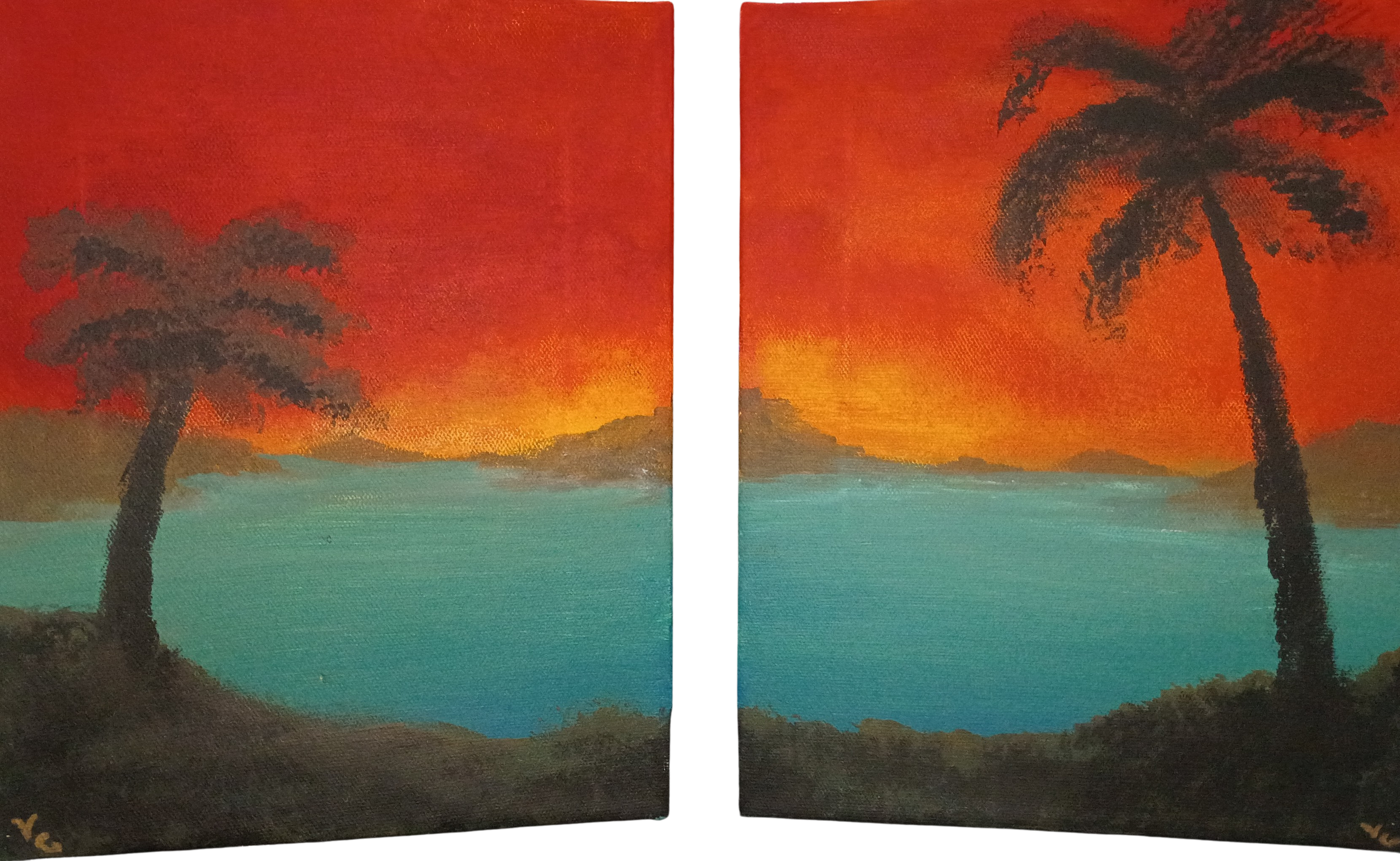
Paradise
Acrylic on Canvas | 8 x 10 in each panel | Diptych
An imagined island where the mind escapes long before the body can.
In Paradise, Vince constructs a two-part window into a place that exists somewhere between memory, desire, and imagination. Painted as a diptych, the composition invites the viewer to stand between two perspectives of the same tropical horizon. Dark silhouettes of palm trees frame the glowing sky, while calm turquoise waters stretch toward distant islands that dissolve softly into the atmosphere.
The burning reds and oranges of the sky evoke the final moments of a tropical sunset, when heat lingers in the air and the landscape seems to breathe more slowly. This warm intensity contrasts with the tranquil blue water below, creating a balance between the sensory weight of summer and the calming presence of the sea. Throughout art history, islands have often symbolized both escape and introspection. From the mythic islands of Greek lore to Gauguin’s paintings of Tahiti, artists have long imagined remote shores as places where ordinary life falls away and something more elemental remains.
The work also carries a personal origin. Created during the suffocating heat of a Sacramento summer, the painting becomes a form of emotional geography. Rather than depicting a real place, Vince paints the place he wished to be. The diptych format reinforces this idea. Each panel feels like a separate glance across the same water, as though the viewer has turned their head slightly while standing on the shoreline.
Paradise therefore becomes more than a tropical landscape. It is a meditation on longing, climate, and imagination. Even when the body is confined to a particular place, the mind remains capable of traveling vast distances. Through color, atmosphere, and symmetry, the painting captures that quiet act of escape.
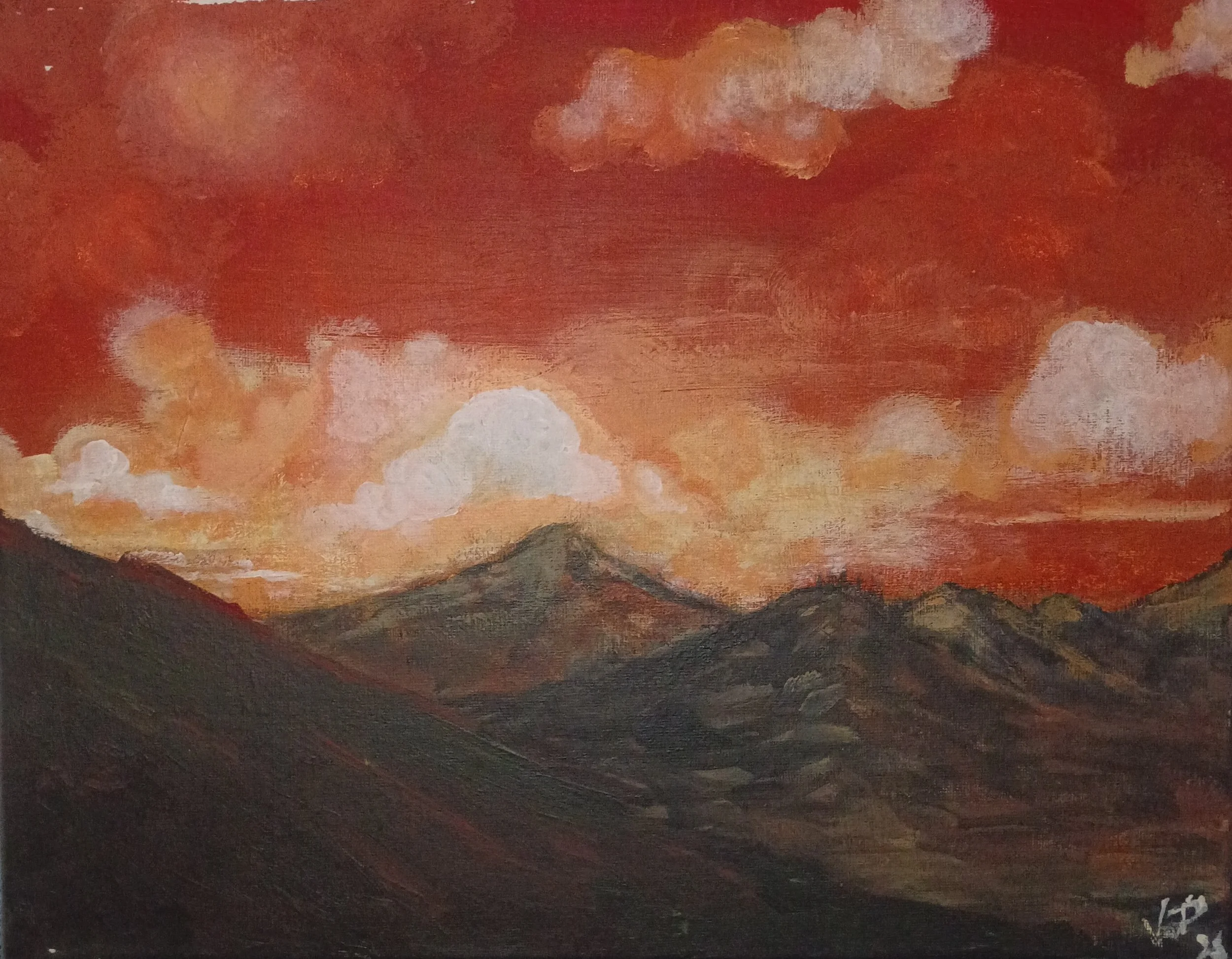
Desert Dream
Acrylic on Canvas | 14 x 11 in
Where the desert sky holds both violence and serenity.
One of Vince’s earlier explorations into landscape painting, Desert Dream captures the paradox that has long defined humanity’s relationship with the desert. The sky dominates the composition in deep reds and burning oranges, suggesting both sunset and fire, creation and destruction. Beneath it, quiet mountain silhouettes rise from shadow, grounding the scene in stillness while the heavens above appear restless and alive.
Historically, deserts have carried powerful symbolic weight. In ancient traditions they were places of revelation and spiritual testing. The deserts of the Near East were where prophets wandered, where silence forced confrontation with the self, and where the harshness of the environment revealed deeper truths about survival and reflection. The painting echoes that duality. The sky feels turbulent and volatile, yet the land itself remains calm, almost meditative.
Vince approached the work without a strict plan, allowing the landscape to emerge organically. This intuitive process mirrors the way deserts themselves form through vast geological time. Wind, heat, and erosion slowly sculpt mountains and valleys into their final shapes. In the same way, the painting came together through instinct rather than rigid intention.
The result is a scene that feels both emotional and elemental. The sky carries an almost violent intensity, while the mountains beneath it hold a quiet endurance. Together they create a visual meditation on contrast. Turmoil above, stability below. A dreamlike desert suspended between chaos and peace.
No results found
No results match your search. Try removing a few filters.