 Image 1 of 1
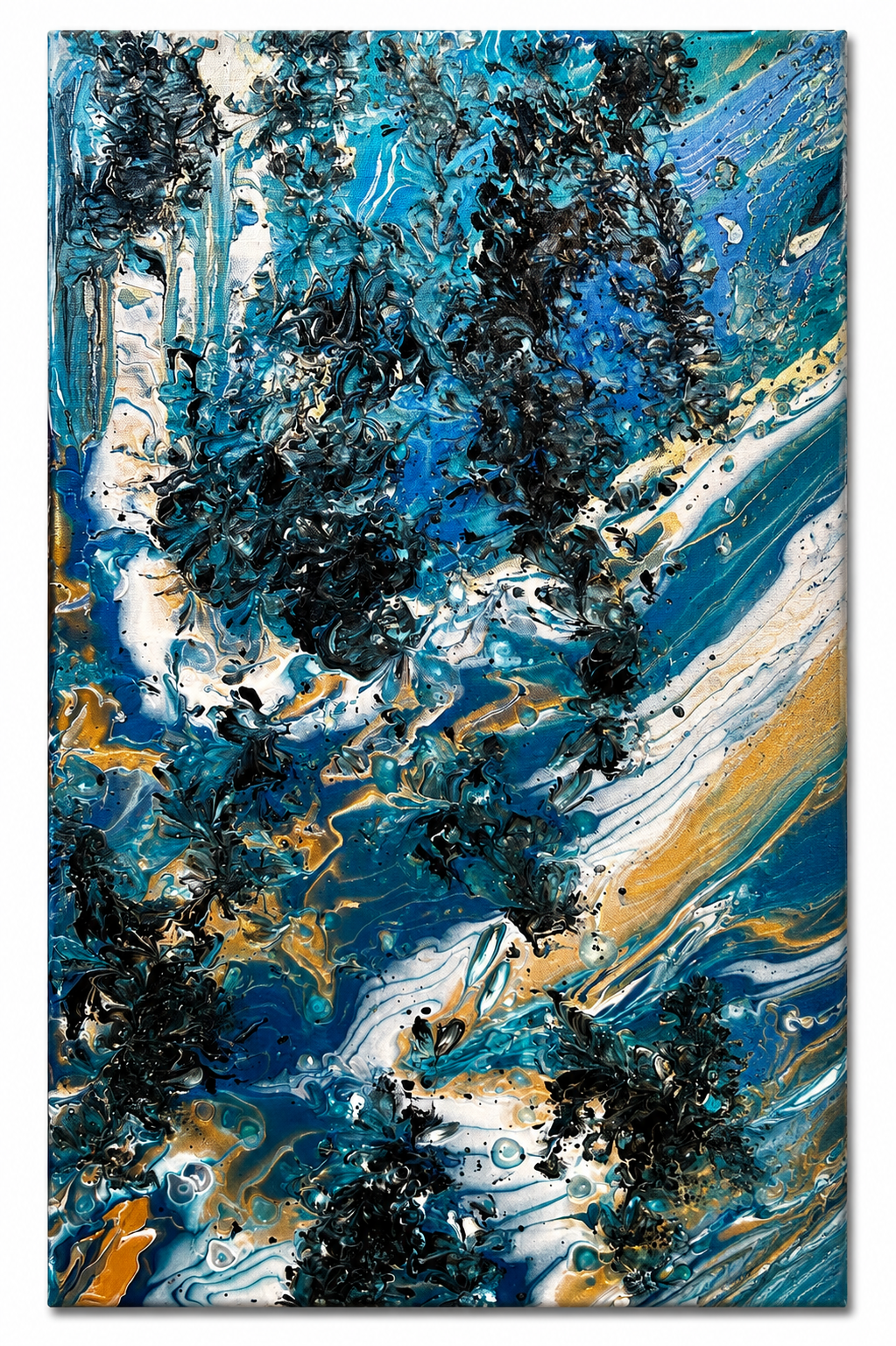
Tears of Gold and Steel
Pouring | Oil on Canvas | 12×24 in
Letting the paint decide where it wants to go.
Tears of Gold and Steel is an exploration of movement, gravity, and pure instinct. Created using the pouring technique Vincent continues to work with today, the piece began with three colors chosen for the way they could exist together without one overpowering the others. From there, the process was deliberately surrendered to the movement of the paint, allowing gravity and physics to determine how the colors would meet, separate, and ultimately become one composition.
There is no clear beginning or end between the colors. They flow into one another, creating forms that seem almost fluid enough to be melting, while gold and steel-like tones emerge and disappear throughout the surface. The effect is spontaneous and constantly shifting, inviting the eye to follow the movement rather than search for a single focal point.
The irony of the finished piece is in its appearance: painted on a particularly hot day, its flowing forms seem to carry the sensation of heat and melting, though the temperature had nothing to do with the process itself. That coincidence became part of the character of the work. Tears of Gold and Steel is ultimately about letting go—starting with a few simple elements, releasing control, and seeing what happens when the paint is allowed to speak for itself.
Tears of Gold and Steel
Pouring | Oil on Canvas | 12×24 in
Letting the paint decide where it wants to go.
Tears of Gold and Steel is an exploration of movement, gravity, and pure instinct. Created using the pouring technique Vincent continues to work with today, the piece began with three colors chosen for the way they could exist together without one overpowering the others. From there, the process was deliberately surrendered to the movement of the paint, allowing gravity and physics to determine how the colors would meet, separate, and ultimately become one composition.
There is no clear beginning or end between the colors. They flow into one another, creating forms that seem almost fluid enough to be melting, while gold and steel-like tones emerge and disappear throughout the surface. The effect is spontaneous and constantly shifting, inviting the eye to follow the movement rather than search for a single focal point.
The irony of the finished piece is in its appearance: painted on a particularly hot day, its flowing forms seem to carry the sensation of heat and melting, though the temperature had nothing to do with the process itself. That coincidence became part of the character of the work. Tears of Gold and Steel is ultimately about letting go—starting with a few simple elements, releasing control, and seeing what happens when the paint is allowed to speak for itself.